
Reviewed · GALWAY TOURS
Galway: Medieval Galway Tour
Galway’s past is hiding in plain sight. This 1.5-hour walking tour turns ordinary streets, shopfronts, and pub facades into a readable map of medieval Galway, with stops at the old city walls, Lynch’s Castle, St. Nicholas’ Church, the Hall of the Red Earl, Kirwan’s Lane, and the Spanish Arch. The price is $23 per person, which is fair for a focused guided walk through the city center.
I especially like the way the tour connects major sights with small human stories, including the grim tale of Walter Lynch and the famous Claddagh ring. I also like that Marteen Lane, a Fáilte Ireland regional guide with more than 11 years of guiding experience and a degree in Heritage Studies, puts care into the legends and storytelling. The main consideration is that the tour moves through streets and historic areas in all weather, and admission to St. Nicholas’ Church costs an additional €5 for adults or €4 at the concession rate.
In This Review
- Key points to know before you go
- Starting at Eyre Square and finding the Browne Doorway
- Seeing the city walls inside Eyre Square Shopping Centre
- Lynch’s Castle and the power of the Fourteen Tribes
- The Lynch Memorial Window and Galway’s darkest family story
- St. Nicholas’ Church, Jane Eyre, and Cromwell’s soldiers
- The King’s Head and the story behind a pub
- Thomas Dillon’s Jewellers and the original Claddagh ring
- Walking into the Hall of the Red Earl
- Kirwan’s Lane and the last medieval lanes
- Blake’s Castle and life in a medieval jail
- Ending at the Spanish Arch and looking toward the Claddagh
- What the $23 price really gets you
- Who should book this Galway walking tour?
- Should you book the Medieval Galway Tour?
- FAQ
- How long is the Medieval Galway Tour?
- How much does the tour cost?
- Where does the tour begin?
- How early should I arrive?
- Where does the tour finish?
- Is admission to St. Nicholas’ Church included?
- What language is the tour conducted in?
- Is the walking tour wheelchair accessible?
- What happens if the weather is severe?
Key points to know before you go
- The tour begins at the Browne Doorway: Meet at this free-standing stone doorway on the north side of Eyre Square, 15 minutes before departure.
- Galway’s medieval walls are tucked inside a shopping center: The remains in Eyre Square Shopping Centre are easy to miss without a guide.
- Lynch’s Castle is still part of daily Galway: The former home of a powerful Lynch family now houses an AIB bank.
- The stories can be dark: The tour explains why James Lynch Fitzstephen hanged his own son in 1493.
- The Claddagh ring gets its proper Galway setting: Thomas Dillon’s Jewellers on Quay Street has made the ring since 1750.
- The walk ends at the Spanish Arch: You’ll finish beside one of Galway’s best-known landmarks, with stories about the Claddagh and a tsunami that destroyed two arches.
Starting at Eyre Square and finding the Browne Doorway
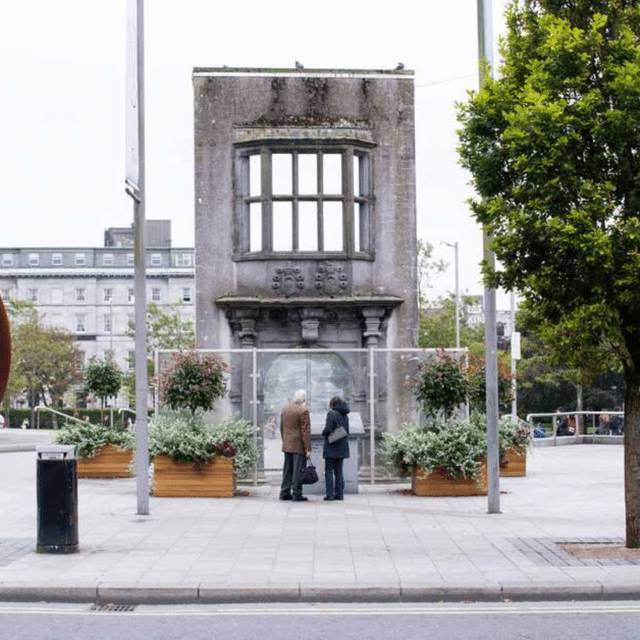
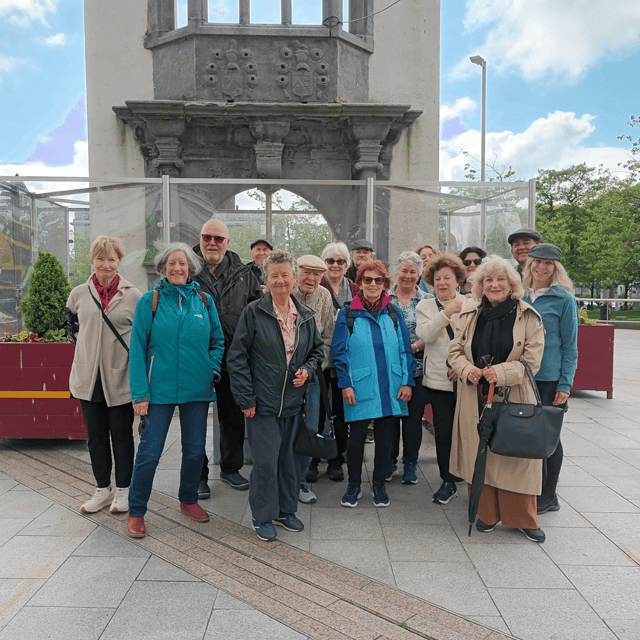
The meeting point is the Browne Doorway in Eyre Square. It is a free-standing stone doorway enclosed by perspex glass on the north side of the square. Arrive 15 minutes early. That small cushion matters on a walking tour because late arrivals can hold up the whole group, and the guide needs to begin on time.
Eyre Square is a useful place to start because it puts you near several layers of Galway at once. The square is a modern city gathering place, but the tour quickly directs your attention toward the traces of the medieval town that are easy to walk past.
You do not need transport for this experience. The route stays in central Galway and finishes back at the starting point, so you can plan it around other sightseeing in the city. Wear comfortable shoes, bring water, and carry an umbrella or weatherproof layer. The walk operates in all weather unless a severe weather warning makes it unsafe.
A few more trips worth weighing up
- Galway to Cliffs of Moher, Aillwee Cave & Dunguaire Castle Tour
★ 5.0 · 3,058 reviews - From Galway: Full-Day Cliffs of Moher & Burren Guided Tour
★ 4.8 · 2,815 reviews - Galway to Inisheer Aran Islands, Cliffs of Moher and Boat Trip
★ 5.0 · 2,517 reviews
Seeing the city walls inside Eyre Square Shopping Centre
One of the tour’s cleverest stops is not in a grand ruin. It is inside Eyre Square Shopping Centre, where remnants of Galway’s medieval city walls have survived among modern retail space.
Without guidance, you might pass through the shopping center and never notice the masonry. The guide explains why the walls mattered to the people of Galway and how they helped define and protect the medieval city. This is a useful reminder that old Galway is not preserved in one neat historic district. Its past is mixed into newer buildings and ordinary city routines.
This stop also sets up the rest of the walk. You begin by looking at Galway as a defended medieval town, then move toward the families, churches, lanes, and trading connections that gave the place its character.
Lynch’s Castle and the power of the Fourteen Tribes
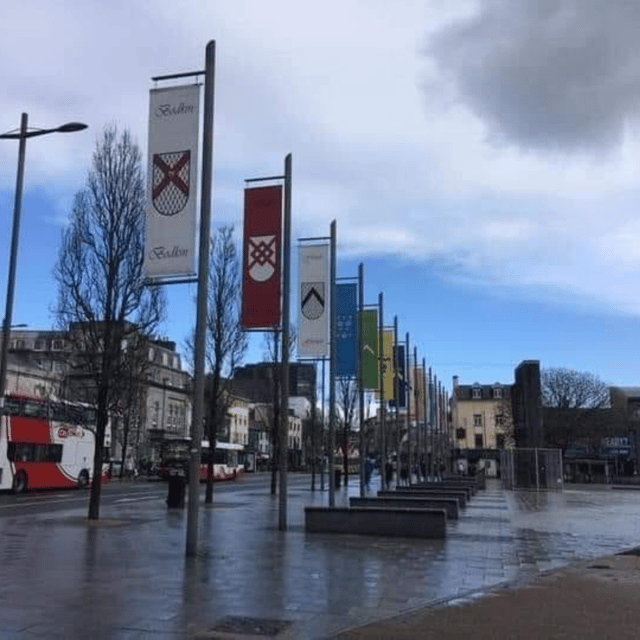
Lynch’s Castle is one of the most memorable stops because the building still serves a modern purpose. It is now an AIB bank, but it is identified as the oldest commercial building in Ireland. The tour introduces you to the Lynch family, one of Galway’s Fourteen Tribes and one of the city’s powerful ruling families.
That combination of medieval family power and present-day banking gives the building extra interest. You are not looking at an isolated monument. You are looking at a historic structure that remains part of the city’s working streets.
The guide uses Lynch’s Castle to explain how family influence shaped Galway. For you, the value is in seeing the building and hearing the social story at the same time. A quick photograph alone would tell you very little. The explanation gives the stonework a reason to matter.
The Lynch Memorial Window and Galway’s darkest family story
Near Lynch’s Castle, the tour reaches Lynch’s Memorial Window. Here you hear the story of James Lynch Fitzstephen hanging his own son Walter in 1493.
It is a hard tale, and it is one reason this walk feels different from a simple list of old buildings. Medieval Galway was not only about merchants, stone walls, and family names. It was also a place where law, authority, reputation, and punishment could collide in severe ways.
The story is presented as part of Galway’s local tradition and urban memory. Marteen Lane’s strength, according to the praise attached to the experience, is the extra care given to legends and stories. That matters here. A grim event can easily become a quick shock detail, but good storytelling gives you a better sense of why the tale has lasted.
A completely different kind of day out from Galway:
- From Galway: Aran Islands and Cliffs of Moher Tour & Cruise
★ 4.8 · 2,283 reviews - Cliffs of Moher & the Burren Tour from Galway
★ 5.0 · 1,913 reviews - From Galway: Cliffs of Moher and The Burren Guided Day Trip
★ 4.7 · 1,770 reviews - From Galway: Connemara and Cong Full-Day Tour
★ 4.7 · 1,737 reviews
St. Nicholas’ Church, Jane Eyre, and Cromwell’s soldiers
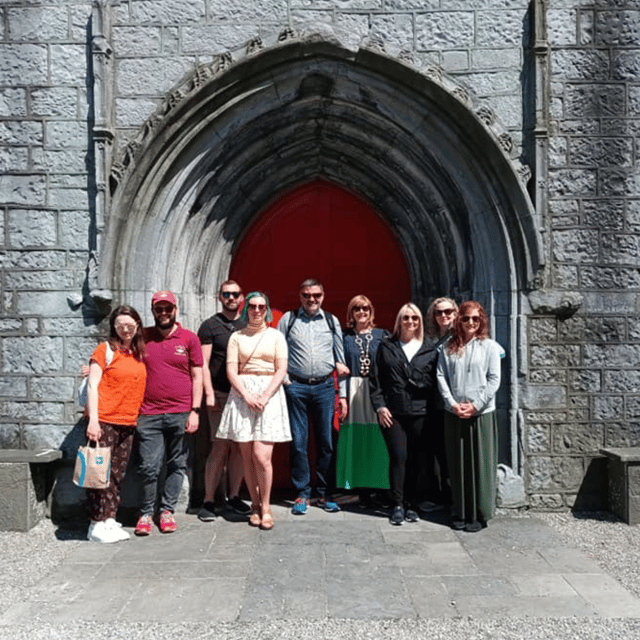
St. Nicholas’ Collegiate Church has been at the heart of Galway for more than 700 years. The exterior and its place in the city make it an important stop, while the tour adds several less expected connections.
You hear about Jane Eyre and James Kearney, then learn how Cromwell’s soldiers used the church as a stable. These details take the church beyond its role as an old religious building. They show how a place can shift from worship to military use and later return to civic and religious importance.
Entrance to the church is not included. Adults pay €5, while the concession price is €4. That extra charge is worth considering before you book, particularly if you are watching every euro. The walking tour can still explain the church if you do not enter, but going inside gives this stop more weight.
The experience is wheelchair accessible, though the route includes historic streets and archaeological areas. If access details are especially important for you, check the current arrangements when booking.
The King’s Head and the story behind a pub
The building now used as the King’s Head Pub is tied to the beheading of King Charles I of England. That is a surprising connection to find in a Galway pub, and it shows how the tour keeps linking local buildings to events beyond the city.
This stop is not simply about admiring an old facade. It gives you a quick lesson in how Galway’s buildings acquired reputations through politics, punishment, and changing ownership. You may also appreciate the contrast between the building’s serious historical connection and its modern role as a place for food and drink.
Alcohol is not allowed as part of the tour, and the experience is not intended for bachelor or bachelorette party groups. That fits the tone of the walk, which is built around close attention to the city and its stories rather than a party atmosphere.
Thomas Dillon’s Jewellers and the original Claddagh ring
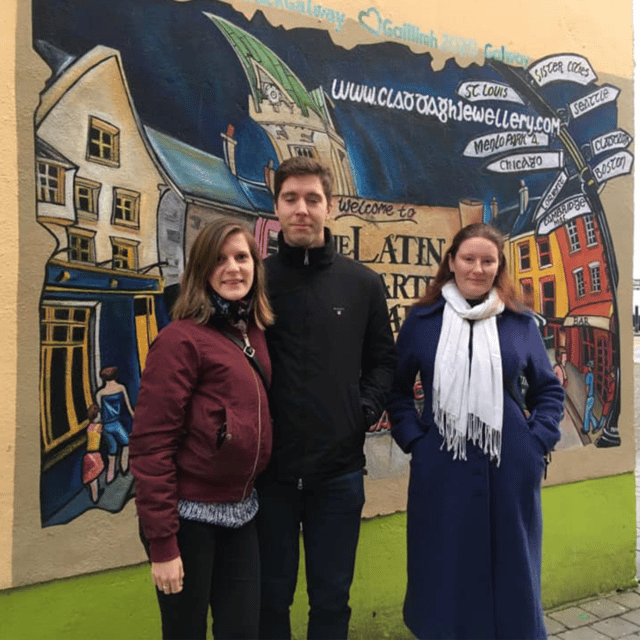
On Quay Street, the tour stops at Thomas Dillon’s Jewellers. The business is identified as the original maker of the famous Claddagh ring, with production dating to 1750.
This is a strong Galway stop because the ring is not treated as a generic souvenir. You hear the story connected with the ring and its place in local culture. If you are considering buying one, the stop gives you useful context before you compare designs or prices.
The location also helps connect Galway’s commercial past with its modern visitor scene. Quay Street is a lively place to walk, but the guide points out the older story beneath the shops. You get a clearer idea of how Galway’s identity was shaped by trade, family businesses, and symbols that traveled far beyond Ireland.
Walking into the Hall of the Red Earl
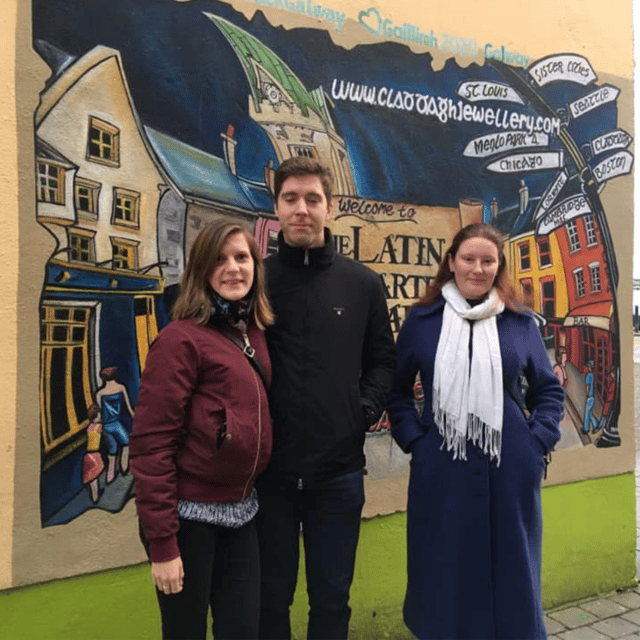
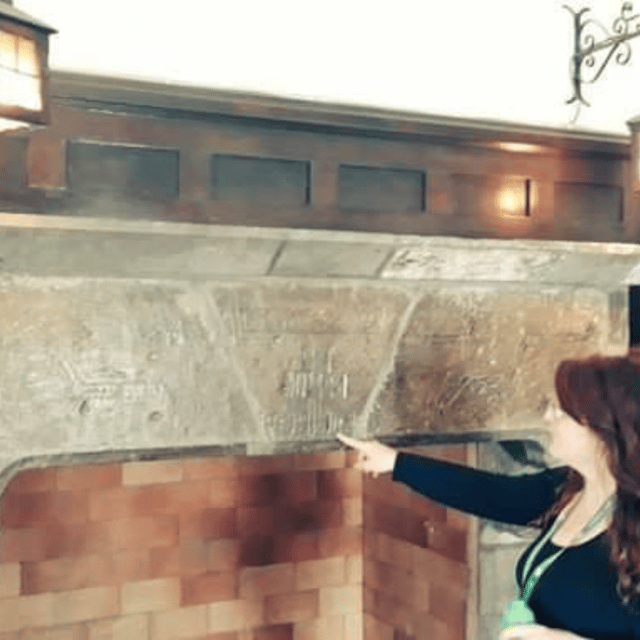
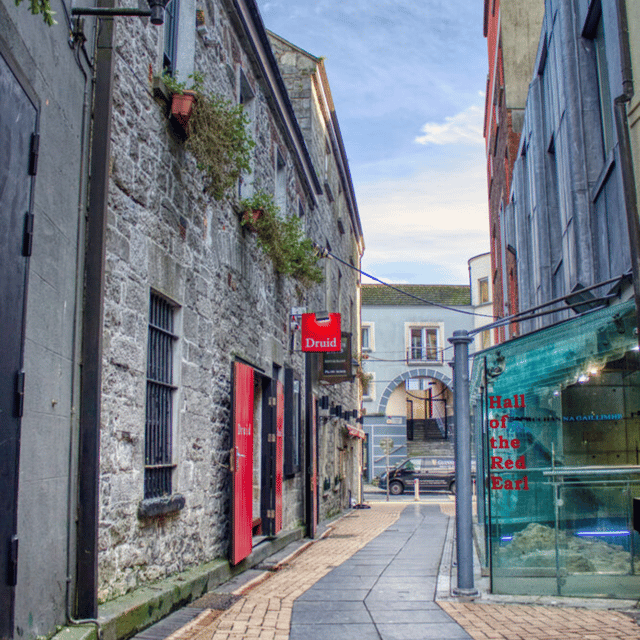
The Hall of the Red Earl is one of the tour’s most valuable archaeological stops. Run by Galway Civic Trust, the site contains remains of walls, columns, and buttresses. The route takes you down into the site, allowing a closer look at the surviving structure.
This is the sort of place that benefits greatly from a guide. Archaeological remains can be difficult to read when you do not know what you are looking at. A wall fragment or column base becomes more useful when someone explains its position and purpose.
The Hall of the Red Earl also adds a physical sense of medieval Galway. You are not only hearing about the period from the pavement. You are stepping down to inspect remains connected with the city’s earlier buildings. Allow a little care here, especially if the surface is wet after rain.
Kirwan’s Lane and the last medieval lanes
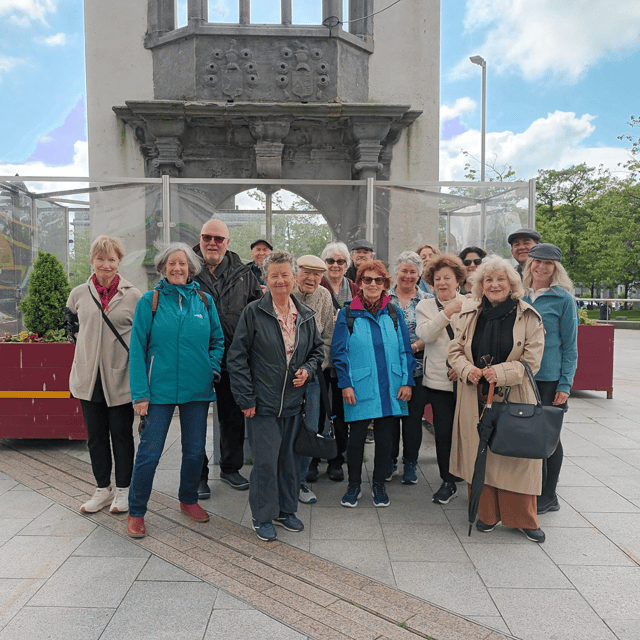
Kirwan’s Lane is one of five lanes still in existence in Galway. It is named for the Kirwan family, another of the Fourteen Tribes, and it preserves remnants of medieval Galway in its buildings and narrow route.
The lane offers a change of scale after the larger sites. City walls and churches explain Galway’s public life, while a lane gives you a better sense of how people moved through the town. You see how family names remain attached to the physical streets.
This part of the walk is especially useful if you like details that are easy to miss. A guide can point out the older parts of the buildings and explain why the lane matters. You might not spend long here, but it helps the city feel less like a collection of isolated attractions.
Blake’s Castle and life in a medieval jail
At the end of Quay Street, you reach Blake’s Castle, associated with the Blake family, one of the Fourteen Tribes. The building once fell into ruin and was restored around the 1980s.
The tour focuses on what life was like for criminals in the jail. That subject gives Blake’s Castle a different mood from Lynch’s Castle. One building represents family influence and wealth, while the other brings you closer to confinement and punishment.
The restoration story is also useful. You see how an old structure can survive after years of decline, then return to the city as a recognizable part of Galway. Do not expect a large castle interior experience here. The value comes from the building’s location, the family connection, and the guide’s explanation of its former use.
Ending at the Spanish Arch and looking toward the Claddagh
The walk finishes at the Spanish Arch, one of Galway’s most familiar sights. The arch once formed part of the city’s defenses and commercial edge, and its position beside the river points you toward the Claddagh across the water.
The guide explains the Claddagh and the tsunami that destroyed two of the arches. That detail adds a reminder that Galway’s waterfront has been shaped by natural forces as well as human construction.
Ending here works well because the Spanish Arch gives you a clear final landmark and leaves you near the river. The activity returns to the meeting point, so you will need to walk back afterward if you want to follow the route in reverse. The closing stop also gives you a natural place to continue exploring on your own.
What the $23 price really gets you
At $23 per person, this is a reasonably priced introduction to Galway’s medieval center. You are paying for 1.5 hours with an English-speaking regional guide, not for admission to a museum or a long excursion outside the city.
The value rests on the interpretation. Several stops are easy to overlook, including the wall remains inside the shopping center and the archaeological features at the Hall of the Red Earl. The tour also brings together family names, local legends, religious history, trade, punishment, and the Claddagh ring in one compact route.
Remember to budget separately for St. Nicholas’ Church, which costs €5 for adults or €4 at the concession rate. If you skip the church entrance, the overall cost remains low, but you lose one part of the experience.
The published rating is 4.7 out of 5 from three ratings. The strongest praise centers on the amount of information and the care Marteen Lane gives to the legends and stories. That is a useful signal for anyone choosing between a self-guided walk and a live guide.
Who should book this Galway walking tour?
I would recommend it to first-time visitors who want a short introduction before exploring Galway independently. It also suits anyone interested in medieval architecture, local families, Irish legends, archaeology, or the stories behind familiar city buildings.
The 1.5-hour length is a good fit if you have limited time. You can learn the basic shape of medieval Galway without giving up half a day. The route is also a sensible choice for anyone who prefers walking and wants to stay in the central city.
This may not be the best match if you want a long museum visit, a private tour, or a highly specialized academic lecture. It is a brisk city walk with a wide range of subjects. Some stops are viewed from outside, and the only listed church admission is extra.
Book with an umbrella and good shoes, and do not treat the weather warning casually. The tour runs in rain and other normal conditions, but a severe weather warning can lead to cancellation, with an alternative date or full refund offered.
Should you book the Medieval Galway Tour?
Book it if you want Galway’s old center to make more sense in a short amount of time. The combination of hidden walls, powerful family homes, a 700-year-old church, an archaeological site, surviving lanes, and the Spanish Arch gives you a useful framework for further sightseeing.
The best reason to choose this tour is Marteen Lane’s story-led approach. You get more than dates and building names. You get the uncomfortable family tale behind Lynch’s Window, the history attached to the Claddagh ring, and the human side of Galway’s medieval streets.
Skip it only if you strongly prefer exploring alone or do not want to pay the additional church entrance fee. For most visitors, $23 is a sensible price for a compact, accessible introduction to Galway’s medieval past.
FAQ
How long is the Medieval Galway Tour?
The tour lasts 1.5 hours. Starting times vary, so check availability when booking.
How much does the tour cost?
The listed price is $23 per person.
Where does the tour begin?
Meet at the Browne Doorway in Eyre Square. It is a free-standing stone doorway surrounded by perspex glass on the north side of the square.
How early should I arrive?
You should arrive 15 minutes before the scheduled start time so the tour can begin on time.
Where does the tour finish?
The activity ends back at the meeting point in Eyre Square.
Is admission to St. Nicholas’ Church included?
No. Adult admission is €5, and the concession price is €4.
What language is the tour conducted in?
The live tour is conducted in English.
Is the walking tour wheelchair accessible?
Yes, the activity is listed as wheelchair accessible.
What happens if the weather is severe?
The tour operates in all weather, but it can be cancelled for safety during a severe weather warning. You will be offered an alternative date or a full refund.
Just added around Galway
- Galway’s Historical Gems: A Walk Through Time★ 5.0 · 3 reviews
- Connemara/Galway: Inis Meáin Return Ferry Transfer★ 4.7 · 3 reviews
- Galway: HerGalway Walking Tour★ 5.0 · 3 reviews
- From Galway: Cliffs of Moher and The Burren Tour★ 5.0 · 3 reviews
- 2.5 Hour Guided Sea Kayaking in Roundstone Bay★ 5.0 · 3 reviews
- Galway Tasting and Walking Tour★ 5.0 · 3 reviews
- Ferry ticket – Day return ticket to Inishbofin Island from Cleggan. Self Guided.★ 5.0 · 3 reviews
- Sean’s Bar, Athlone Castle and Clonmacnoise Monastery★ 4.5 · 3 reviews
Galway Tours, compared.

Galway to Cliffs of Moher, Aillwee Cave & Dunguaire Castle Tour
Read our review →
Full-Day Cliffs of Moher & Burren Guided Tour
Read our review →
Galway to Inisheer Aran Islands, Cliffs of Moher and Boat Trip
Read our review →
Aran Islands and Cliffs of Moher Tour & Cruise
Read our review →
Cliffs of Moher & the Burren Tour from Galway
Read our review →
Cliffs of Moher and The Burren Guided Day Trip
Read our review →
Galway to Aran Islands Inisheer, Doolin, Cliffs of Moher Day Tour
Read our review →Browse the lists this tour appears in