
Reviewed · CANOES & KAYAKS
Dublin: Music Under the Bridges Kayaking Tour
Hear Dublin from the water. This unusual Liffey kayaking tour mixes gentle paddling, city views, and private live music beneath the bridges at the heart of Dublin. You launch from the Liffey Boardwalk between Ha’penny Bridge and O’Connell Bridge, then paddle through the city center toward a series of musical stops.
I like the way this turns a familiar city walk into something active and fresh. I also like the intimate concerts, especially when a singer-songwriter such as Cara Coyle or Mark Flynn performs beneath a bridge and lets the river provide the sound system. The main caution is timing: the advertised duration is 2.5 hours, but one account described a shorter outing, so confirm the schedule when you book.
In This Review
- Key points to know before you paddle
- Starting between Ha’penny and O’Connell bridges
- Learning the basics in a stable sit-on-top kayak
- Paddling through the heart of Dublin
- The private concert beneath a bridge
- What the bridges sound like after dark
- How the two-and-a-half hours are used
- Is $67 a fair price?
- Who should book this Liffey experience?
- My verdict on Music Under the Bridges
- FAQ
- Where does the Music Under the Bridges kayaking tour start?
- Where does the tour finish?
- How long does the tour last?
- Do I need kayaking experience?
- What equipment is included?
- What language is the tour conducted in?
- What should I wear?
- Can people with mobility impairments join?
Key points to know before you paddle
- Live music beneath Dublin’s bridges: The concerts take place on the water, with bridge arches creating striking natural acoustics.
- A central launch point: You meet at the Liffey Boardwalk on Bachelors Walk, between Ha’penny Bridge and O’Connell Bridge.
- Beginner-friendly kayaks: Stable sit-on-top kayaks, paddles, seats, and life jackets are provided, with instruction before you set off.
- A new view of central Dublin: You pass under bridges including O’Connell, Rosie Hackett, Loopline, Talbot Memorial, Sean O’Casey, and Samuel Beckett.
- A two-and-a-half-hour booking: Check the available start times, and allow enough room in your day for possible changes in the pace of the outing.
- Weather matters: Dress for Irish conditions. The tour runs outdoors, and even a calm river can feel cool when you are sitting on the water.
Starting between Ha’penny and O’Connell bridges
The meeting point is easy to place on a Dublin map: the Liffey Boardwalk on Bachelors Walk, in Dublin 1. The pontoon sits between Ha’penny Bridge and O’Connell Bridge, right in the city center.
That location is a real advantage. You do not need to spend half an afternoon reaching a distant marina, and you can pair the tour with a walk around Temple Bar, the O’Connell Street area, or the north bank of the river. Give yourself time to find the pontoon, though. The starting point is central, but a busy city center can make the final few minutes slower than expected.
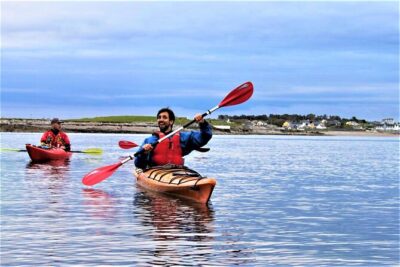
At the pontoon, you get set up in a sit-on-top kayak. This style is less enclosed than a traditional touring kayak and generally feels approachable for first-timers. You receive a kayak seat, paddle, and life jacket, and the guide explains the basic skills needed to move and steer.
That instruction is important even if the kayaks look simple. You need to know how to paddle in rhythm, turn, slow down, and keep a reasonable distance from the other boats. The guide then leads the group from the pontoon and keeps the activity organized on the river.
A few more trips worth weighing up
- Dublin Bay Seal Kayaking Safari at Dalkey
★ 5.0 · 380 reviews - Connemara Coastal kayaking
★ 5.0 · 200 reviews - Kayaking & Canoeing in Limerick City
★ 5.0 · 128 reviews
Learning the basics in a stable sit-on-top kayak
You do not need previous kayaking experience. The tour is designed to teach you the essentials before heading into the central stretch of the Liffey, and several outings have been praised for friendly, supportive instruction.
Max Cody is one guide associated with the experience, and Emily has also handled the launch and group setup. The exact guide can change, but the tone is practical rather than intimidating. That matters if your last encounter with a paddle was on a school holiday, or if you have never sat in a kayak at all.
A sit-on-top kayak gives you an open feel and makes it easy to look around. You are not sealed into a narrow cockpit, which can make the first few minutes less stressful. Still, you should be comfortable with basic balance and paddling, and you should not expect this to be a completely passive boat ride.
The activity is not recommended for people with limited mobility, despite the supplied information also identifying it as wheelchair accessible. Those two notes do not fully explain the practical setup at the pontoon or the transfer into a kayak. If you have a mobility impairment, ask City Kayaking Dublin for a clear, specific answer before paying.
Paddling through the heart of Dublin
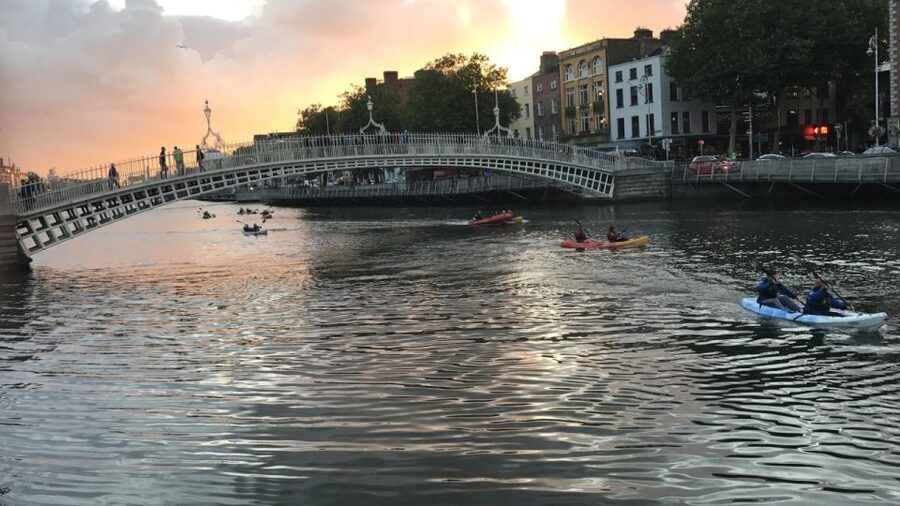
Once the group leaves the pontoon, the city begins to look different almost immediately. From the river, you see the underside of bridges, the riverbanks, the boardwalk, and the buildings rising beyond them. Familiar structures become part of a moving scene rather than something you simply pass on foot.
The route can take you beneath O’Connell Bridge, Rosie Hackett Bridge, the Loopline Bridge, Talbot Memorial Bridge, Sean O’Casey Bridge, and the Samuel Beckett Bridge. Each crossing has a different shape and setting, so the paddle gives you a useful sense of how central Dublin connects across the Liffey.
O’Connell Bridge is the most central of these crossings and a good early reminder that you are kayaking through the middle of the capital, not out in a remote nature reserve. The Loopline Bridge brings a more industrial note, while the Samuel Beckett Bridge, with its distinctive harp-like form, is one of the city’s most recognizable modern sights.
Some trips have paddled toward Dublin Bay before turning back. The direction and exact route can depend on the day, the group, and conditions on the river, so you should treat the named bridges as likely highlights rather than a guaranteed checklist.
The activity is not built around speed. You paddle to the music boats, gather beneath bridges, listen for a while, and then move on. That relaxed pace gives you time to look up at the bridge structures and watch the city from the water, though anyone hoping for a vigorous kayaking workout may find the concert stops reduce the amount of paddling.
The private concert beneath a bridge
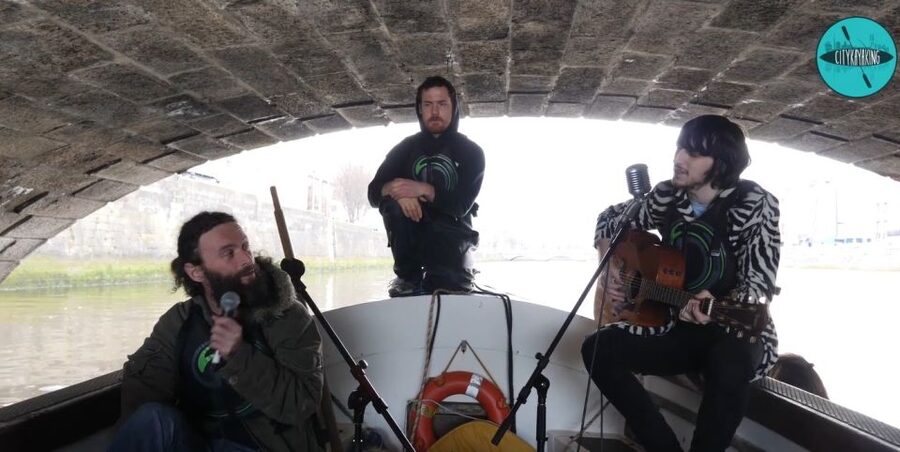
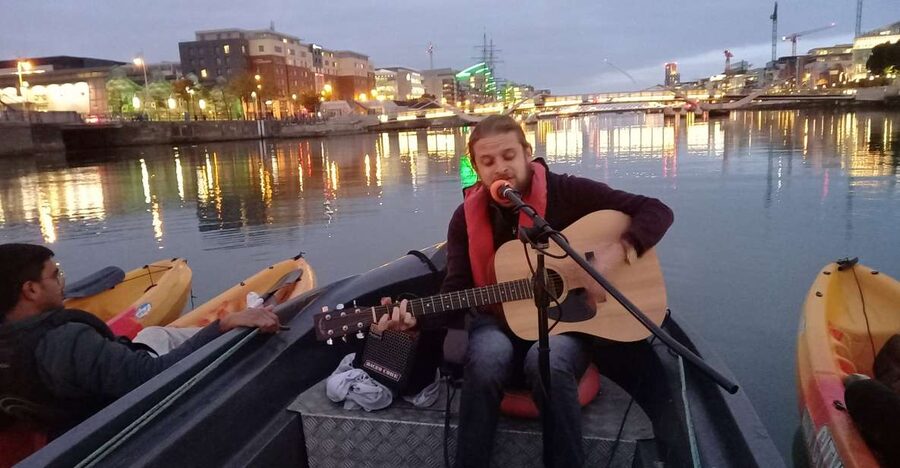
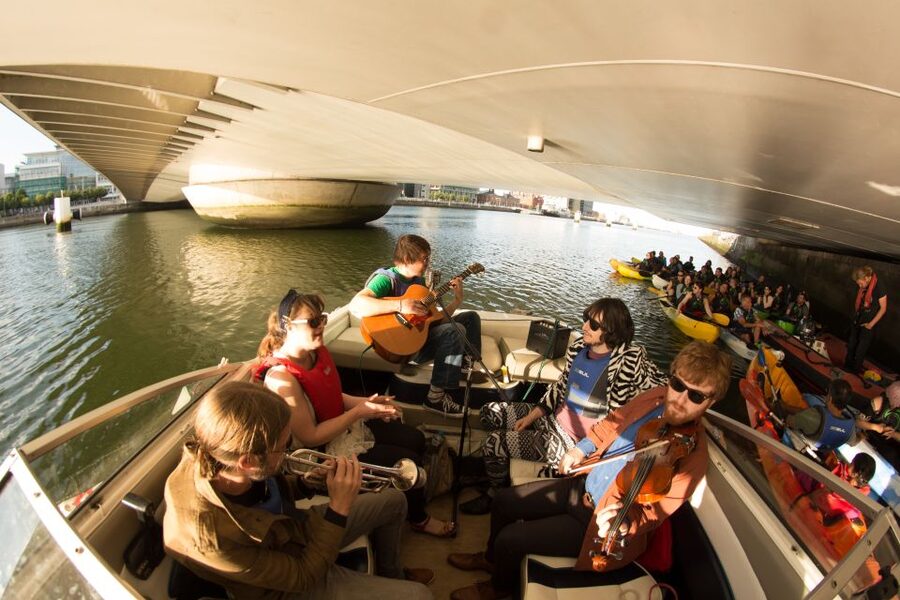
The musical part is what makes this experience more than a standard city kayak. The group stops beneath selected bridges while local musicians perform from stage boats or nearby on-water positions.
Bridge acoustics give the music its special character. The hard surfaces reflect the sound, and the enclosed space under an arch makes a small performance feel unusually close. You are not sitting in a formal venue with rows of seats. You are floating in a kayak, listening from the river, with Dublin passing above and around you.
Performers have included singer-songwriters Cara Coyle and Mark Flynn. Coyle has performed original songs accompanied by guitar, while Flynn has played a set of well-known songs. The lineup is not fixed in the information provided, so do not book expecting one particular artist unless the operator confirms it.
The program can also include songs about love, difficult relationships, and death. That is a distinctly Irish sort of evening: informal, musical, and not afraid of a slightly melancholy turn. If you prefer a tightly planned concert with a guaranteed setlist, this may feel loose. If you enjoy local music in an unusual setting, the lack of a polished theater atmosphere is part of the appeal.
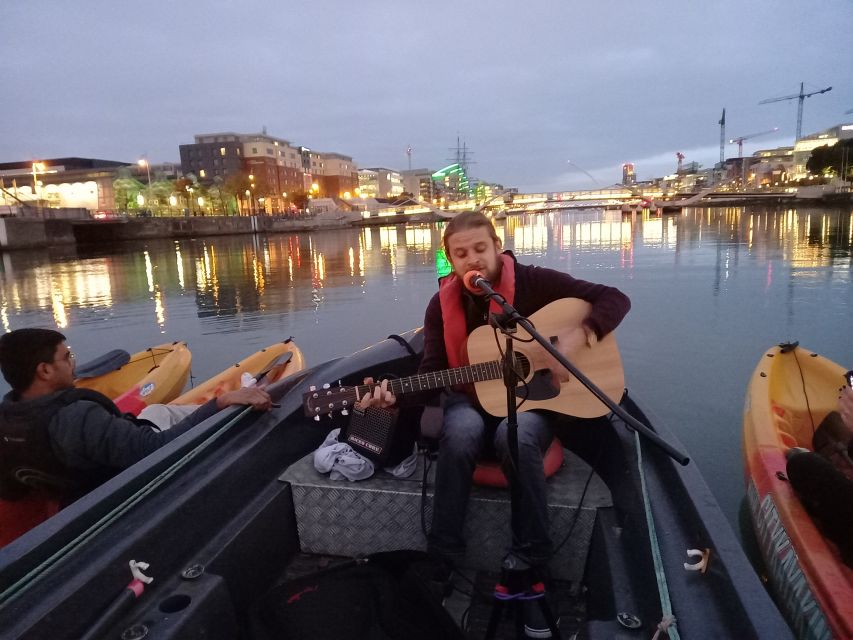
One of the strongest moments can come after the main stop, when the musician continues with a few songs as the kayaks float downstream. Twilight, city lights, and a voice carrying over the Liffey can make the return feel like part of the concert rather than a simple trip back.
A completely different kind of day out from Dublin:
- Dublin to Cliffs of Moher, including Wild Atlantic Way and Galway
★ 5.0 · 23,331 reviews - From Dublin: Cliffs of Moher, Burren & Galway City Day Tour
★ 4.8 · 18,888 reviews - Dublin: Guinness Storehouse Entry Ticket
★ 4.6 · 16,863 reviews - Dublin to Cliffs of Moher, Burren, Wild Atlantic Way, Galway Tour
★ 5.0 · 12,924 reviews
What the bridges sound like after dark
Evening departures appear to be especially appealing. Lit bridges take on a different character from the river, and the water gives you a low, open viewpoint that pedestrians do not get.
You should not assume every departure will be at night. Start times vary, and you need to check availability for the date you want. A daytime outing gives you clearer views of the bridges and city buildings, while an evening outing can offer more atmosphere and better contrast between the dark water and illuminated structures.
Weather also changes the mood. A sunny day may make the river feel easy and sociable, while a gray or cool day calls for extra layers and a waterproof outer jacket. The supplied advice is simple: dress for the weather. I would take it seriously, since you cannot duck into a warm café while you are stopped under a bridge.
The tour is likely most enjoyable when you accept that the river is part of the experience. You may feel a few drops from paddle movement, and your hands can become cool. Wear clothes you can move in, choose practical footwear, and avoid bringing anything that cannot handle a little water.
How the two-and-a-half hours are used
The listed duration is 2.5 hours. That includes meeting, getting equipped, learning the basics, paddling through the city, stopping for music, and returning to the original pontoon.
The timing should feel generous enough for a beginner-focused outing. You are not rushed straight from the launch into a demanding route, and the music stops give the group a chance to rest. One account did report an outing lasting about 1 hour and 45 minutes, which is a notable difference from the published length.
That does not necessarily mean every trip finishes early. River conditions, the pace of the group, and the amount of time spent listening can affect the day. Still, if you are arranging dinner, theater tickets, or a train afterward, leave a buffer and check the expected return time with City Kayaking Dublin.
The tour ends where it begins, at the Liffey Boardwalk. That makes planning easier than an activity with a distant finish point. You can walk directly into central Dublin once you return, although you may want a dry layer or a change of clothes if the weather has been wet.
Is $67 a fair price?
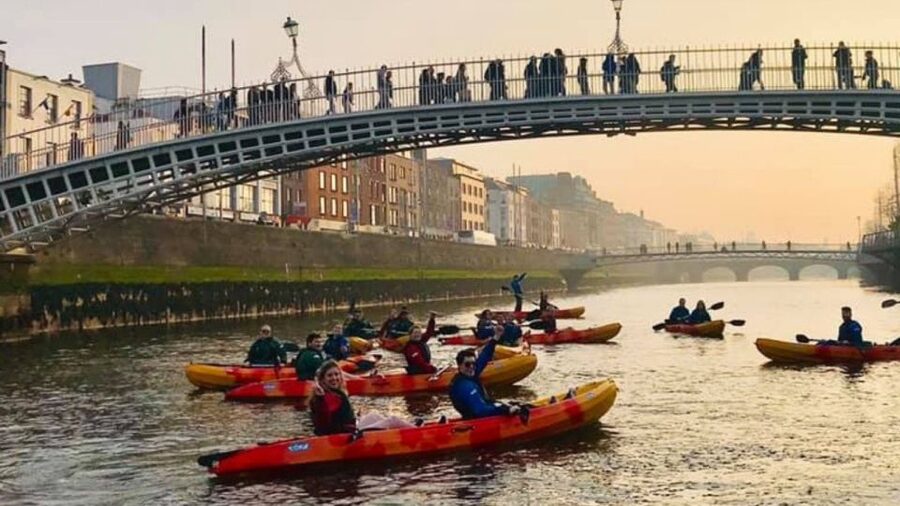
At $67 per person, this costs more than a basic self-guided paddle, but it includes several parts that would be hard to arrange separately. You get equipment, safety gear, instruction, a guide, a central route through Dublin, and live music performed for the group.
The value depends on what you want from a city activity. If your priority is covering as much distance as possible by kayak, this is not the most efficient use of your money because concert stops take up part of the time. If you want an original evening that combines an activity with a small local performance, the price is easier to justify.
I see it as a good choice for a birthday, a couple’s outing, or a small group looking for something beyond pubs and walking tours. It also offers a useful break after several days of sightseeing, when your feet need a rest but you still want to do something active.
The experience has a strong social side, but the intimate format may work best when you book with an even-numbered group so people can pair up comfortably. Families can enjoy it too, and no kayaking background is required, though every participant should be ready to follow instructions and manage a paddle.
Who should book this Liffey experience?
I would recommend it to you if you like local music, unusual city viewpoints, and gentle outdoor activities. It suits first-time kayakers who want guidance rather than a technical lesson, and it gives repeat visitors a fresh way to see central Dublin.
It is also a good fit for people who have already spent time around the Liffey on foot. You may recognize the bridges and streets, but the river changes the scale of the city. Looking up from beneath an arch is a small but memorable shift in perspective.
You should think twice if you dislike being outdoors in uncertain weather or if you want a hard workout. The kayaking is real, but the trip is built around floating, listening, and looking around. People with limited mobility should contact the operator first because the practical accessibility information is not fully consistent.
Cancellation is flexible up to 24 hours before the activity for a full refund, and you can reserve now and pay later. Those options help if your Dublin schedule is still taking shape, but they do not remove the need to check the start time and return window.
My verdict on Music Under the Bridges
Book this tour if you want Dublin to sound and look different for an afternoon or evening. The best parts are clear: excellent bridge acoustics, friendly beginner support, and the pleasure of hearing local musicians while your kayak drifts through the center of the city.
I would not choose it as a substitute for a long-distance river expedition or a serious training session. I would choose it as a memorable city break activity, especially for a birthday, a family outing, or a pair of friends who want something more personal than another indoor attraction.
At $67, it is good value for the combination of equipment, guiding, sightseeing, and live music. Just dress for the weather, allow extra time around the advertised 2.5 hours, and confirm accessibility needs before booking.
FAQ
Where does the Music Under the Bridges kayaking tour start?
It starts at the Liffey Boardwalk on Bachelors Walk, North City, Dublin 1, Ireland. The pontoon is between Ha’penny Bridge and O’Connell Bridge.
Where does the tour finish?
The activity ends back at the original meeting point on the Liffey Boardwalk.
How long does the tour last?
The listed duration is 2.5 hours. One account described a shorter outing of about 1 hour and 45 minutes, so check the expected timing when you book.
Do I need kayaking experience?
No. The guide teaches you the basic skills needed to kayak, and the tour uses stable sit-on-top kayaks.
What equipment is included?
A kayak seat, paddle, and life jacket are included. Private concerts on the water are also part of the experience.
What language is the tour conducted in?
The live guide and tour information are in English.
What should I wear?
Dress for the weather. You will be outdoors on the river, so practical clothing suited to the conditions is important.
Can people with mobility impairments join?
The information describes the activity as wheelchair accessible but also says it is not recommended for people with limited mobility. Contact City Kayaking Dublin before booking to clarify whether the launch and kayak setup suit your needs.
Just added around Dublin
- A Self Guided Walking Tour of Dublin’s Docklands★ 4.5 · 3 reviews
- Waterford Crystal and Kilkenny Full-Day Rail Tour from Dublin★ 5.0 · 3 reviews
- Turtle Bunbury’s Dublin: A Self-Guided Audio Tour from a Celebrated Author★ 5.0 · 3 reviews
- Secret and unusual Dublin: guided walking tour★ 5.0 · 3 reviews
- Cliffs of Moher and The Burren Private Tour from Dublin★ 5.0 · 3 reviews
- Skip-the-line St. Patrick’s Cathedral and Dublin City Tour★ 5.0 · 3 reviews
- Dublin Full-Day Tour through Boyne Valley★ 5.0 · 3 reviews
- Rock Of Cashel And Blarney Castle Private Chauffeur Full Day Sightseeing Tour★ 4.5 · 3 reviews
Canoes & Kayaks, compared.

Browse the lists this tour appears in