
Reviewed · WALKING TOURS
A Self Guided Walking Tour of Dublin’s Docklands
Dublin’s waterfront tells two stories. This self-guided audio walk links the old port, labor movement, famine memory, and modern financial district in about 50 minutes to 1 hour 10 minutes. I like the clear local narration and the freedom to stop, look around, or take the route at your own speed.
I also like the offline maps and audio, which help you avoid using mobile data as you walk. The main drawback is simple: you need your own smartphone and headphones, and the experience is non-refundable, so check your plans before booking.
In This Review
- Key points to know before you go
- Why Dublin’s Docklands rewards a walking tour
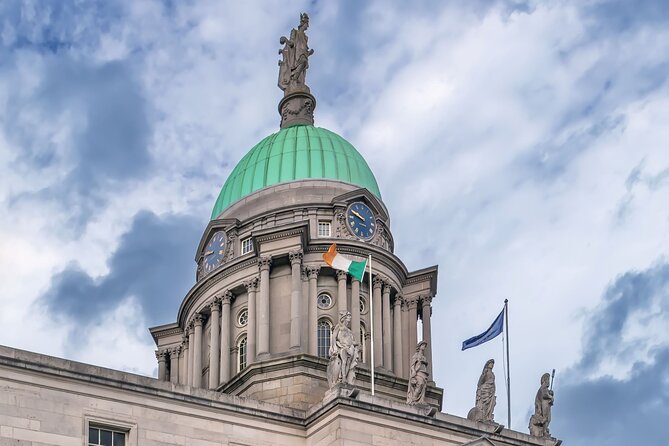
- Starting beside the Custom House
- The quays, James Connolly, and Dublin’s labor story
- The IFSC and the changing face of the port
- Bridges, machinery, and the working water
- Famine memory and the Jeanie Johnston
- The Samuel Beckett Bridge and Convention Centre Dublin
- East Link, BrewDog, and the Grand Canal basin
- Finishing at Grand Canal Square
- How the audio format works in real use
- Price, length, and who gets good value
- Who should choose this Docklands walk?
- Should you book this Dublin Docklands tour?
- FAQ
- How long does the Dublin Docklands audio tour take?
- Where does the tour begin?
- Where does the tour end?
- What language is the tour offered in?
- Do I need my own smartphone?
- Do I need headphones?
- Can I use the tour without mobile data?
- Is this a group tour?
- Can I use the tour more than once?
- Is the tour refundable if I cancel?
Key points to know before you go
- The route begins at the Custom House and ends at Grand Canal Square, giving you a clear north-to-south walk through the Docklands.
- You hear about old maritime Dublin and modern city life in one outing, from famine ships and dock machinery to banks, offices, and new apartments.
- The narration keeps the pace manageable, according to the available feedback, and helps point out details you could otherwise miss.
- Offline access matters in practice, especially if your phone plan charges for data abroad.
- The route is private and self-guided, so only your group takes part and there is no fixed group departure.
- At $11.99 per person, the tour is good value for a short orientation walk, particularly if you want context without paying for a full guided excursion.
Why Dublin’s Docklands rewards a walking tour
Dublin’s Docklands is not one neatly preserved historic quarter. It is a working port area, a place of transport, memorials, offices, bridges, old industrial structures, and newer buildings. That mix can be hard to read without some explanation.
An audio route gives you a useful thread to follow. Instead of simply walking from one modern building to the next, you learn how trade, shipping, transport, labor, emigration, and finance shaped this part of the city.
I like the way the route joins sights that might otherwise feel disconnected. The Custom House introduces Ireland’s trading past. The Famine Memorial and Jeanie Johnston point to emigration and hardship. The IFSC, Convention Centre Dublin, and Grand Canal Square show how the waterfront has changed.
The walk is also short enough to fit around a larger Dublin plan. You can use it as a morning introduction, an afternoon change from the city center, or a practical route toward the Grand Canal area.
More Walking Tours in Dublin
- Dublin Highlights and Hidden Gems Guided Walking Tour
★ 5.0 · 6,020 reviews - Dublin: Highlights and Hidden Gems Walking Tour
★ 4.9 · 2,140 reviews - 1916 Rebellion Walking Tour
★ 5.0 · 1,605 reviews
Starting beside the Custom House
The tour begins at the Custom House on North Wall. This grand neoclassical building once served as a center of Irish trade and commerce, making it an apt starting point for a walk about Dublin’s port.
The location is easy to reach. Busáras and nearby Luas and bus stops are close, and Tara Street DART station is also accessible. From O’Connell Street, the starting point is about a 10-minute walk. From College Green, allow about 15 to 20 minutes.
You should arrive with your phone charged and your headphones ready. Since the tour starts through GPS, make sure you have downloaded the audio, map, and geodata before setting off.
The first section gives you a useful sense of place. You are not starting in a quiet museum courtyard. You are starting in an area connected to trade, transport, and the movement of people.
The quays, James Connolly, and Dublin’s labor story
From the Custom House, the route follows the quayside. Historic warehouses and newer development sit near one another, making this one of the clearest parts of the walk for seeing how the Docklands changed over time.
The audio also brings you toward the memorial to James Connolly, a major figure in Ireland’s independence struggle and in the fight for workers’ rights. This adds a social and political layer to the tour. Dublin’s docks were not only about cargo and commerce. They were also tied to working people, organized labor, and national politics.
Nearby, you pass Liberty Hall Theatre. Its importance in labor movement history makes it more than just another city building. I appreciate that the route includes these civic and political landmarks instead of focusing only on architecture.
The stop at Busáras adds another piece to the story. Dublin’s central bus station is a practical transport hub, but here it also helps you understand how the Docklands remains tied to movement through the city.
You then pass Connolly Train Station, one of Dublin’s principal railway stations. The combination of Busáras and Connolly Station makes this part especially useful for orientation. If you are arriving or leaving by public transport, you will recognize the area quickly.
The IFSC and the changing face of the port
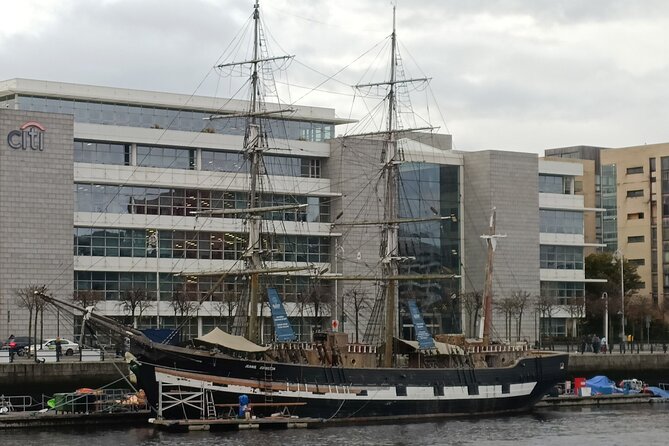
The route continues past the International Financial Services Centre, or IFSC. This is one of Dublin’s major financial districts, with multinational companies and financial institutions occupying a part of the old dock area.
The contrast is the point. Warehouses, rail lines, port structures, banks, and office buildings are all part of the same story. The tour helps explain the change from a maritime working district to a modern business center.
You also pass the Triumphal Arch, a historic monument linked with Dublin’s maritime heritage and economic success. Its presence reinforces the older identity of the area, while the IFSC points toward its newer role.
One consideration is that this section may appeal more to people who enjoy urban change and city planning than to those looking only for picturesque old streets. The Docklands has plenty of striking sights, but it is also a working city district. You will encounter offices, roads, transport links, and modern construction alongside the older landmarks.
A completely different kind of day out from Dublin:
- Dublin to Cliffs of Moher, including Wild Atlantic Way and Galway
★ 5.0 · 23,331 reviews - From Dublin: Cliffs of Moher, Burren & Galway City Day Tour
★ 4.8 · 18,888 reviews - Dublin: Guinness Storehouse Entry Ticket
★ 4.6 · 16,863 reviews - Dublin to Cliffs of Moher, Burren, Wild Atlantic Way, Galway Tour
★ 5.0 · 12,924 reviews
Bridges, machinery, and the working water
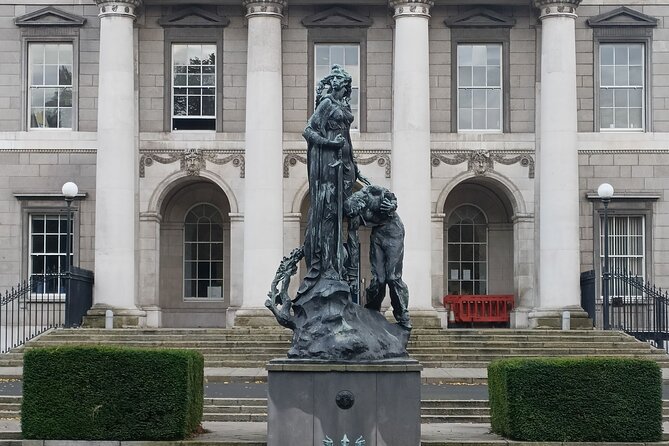
The Scherzer Rolling Lift Bridges are among the more unusual engineering sights on the route. These bridges once helped maritime traffic move through the Docklands. They are a reminder that the water was not just scenery. It was part of a functioning port system.
The route then brings you toward the River Liffey and the Seán O’Casey Bridge. Crossing here gives you broad views of the waterfront and Dublin’s skyline. It is one of the natural pause points on the walk, so you may want to stop the audio briefly and take in the view.
You also pass the memorial to Irish seafarers who lost their lives at sea. This is a quieter, more reflective stop. It connects the docks to the risks faced by people who worked on the water and reminds you that maritime trade had a human cost.
The historic Diving Bell offers another unusual detail. It was used for maintenance work in Dublin’s port. For many people, this will be one of the less familiar objects on the route. The audio is particularly useful here because the structure could be easy to pass without understanding its purpose.
Famine memory and the Jeanie Johnston
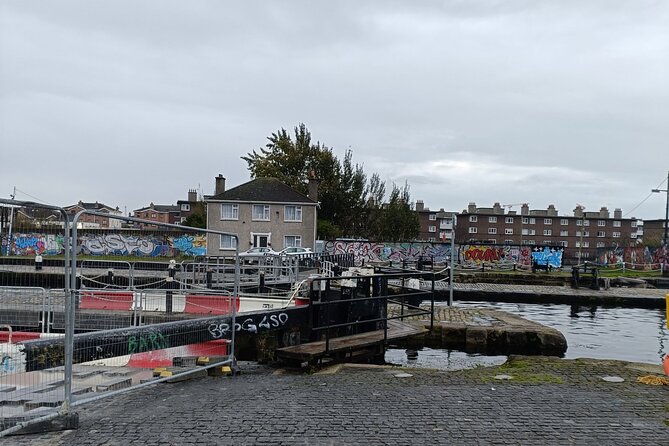
The Famine Memorial is one of the most serious parts of the walk. It honors those who suffered during Ireland’s Great Famine in the 19th century. The location along the river is fitting, since the docks were tied to departure, migration, and the movement of people out of Ireland.
Nearby, you see a replica of the Jeanie Johnston, the ship associated with Irish emigrants traveling to North America during the famine period. Together, the memorial and ship give the route emotional weight.
I like that this part does not treat the Docklands as a collection of attractive waterfront views. It asks you to consider why people were leaving Ireland and what the river meant to them.
The route does not present this as a long museum visit. You are seeing the memorial and ship from the outside as part of a walking circuit, with the audio providing context. If you want detailed exhibits or an extended ship visit, you would need to arrange that separately. For a short orientation, the combination works well.
The Samuel Beckett Bridge and Convention Centre Dublin
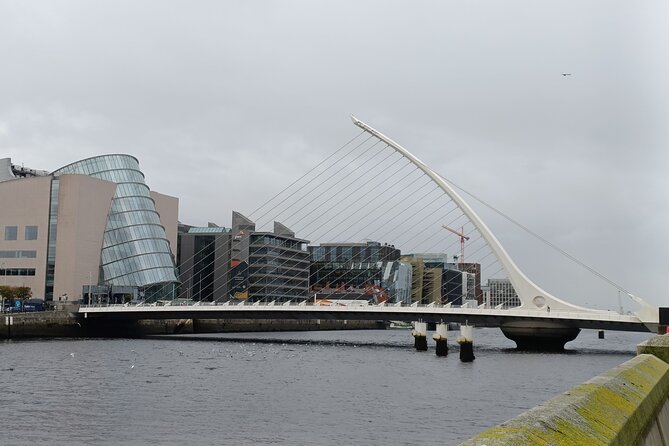
The Samuel Beckett Bridge is one of the Docklands’ best-known modern landmarks. Named for the Irish writer, its distinctive form gives the river crossing a strong visual identity.
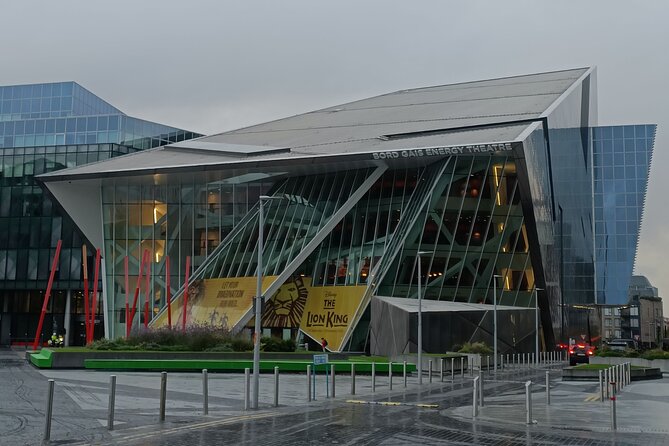
From there, the walk passes the Convention Centre Dublin, a modern venue for conferences, events, and exhibitions. The building helps show how the riverfront has been adapted for contemporary business and culture.
This stretch is a good example of the tour’s broad subject. You move from famine history and old dock machinery to modern architecture within a short distance. The audio helps keep those changes connected rather than making them feel like unrelated stops.
The route also passes a statue of Admiral William Brown, an Irish-born naval officer who founded the Argentine Navy. This is the sort of detail an independent walk can easily miss. A statue may look like background decoration until you know why the person matters.
East Link, BrewDog, and the Grand Canal basin
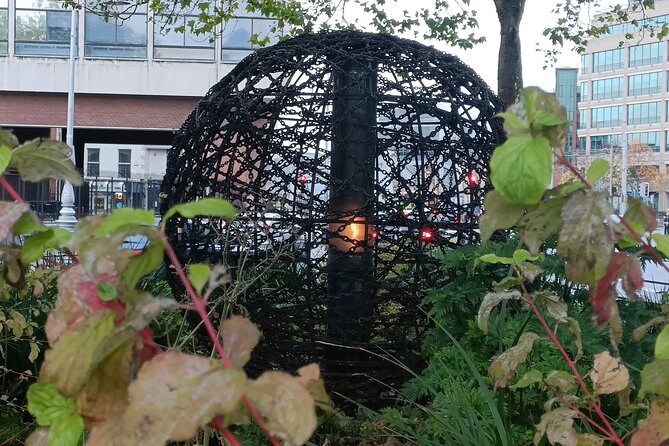
The Tom Clarke Bridge, also known as the East-Link Bridge, connects Dublin’s north and south sides and carries important traffic across the river. Seeing it from the route gives you another view of how transport shapes the Docklands.
You then pass BrewDog Outpost Dublin, a craft brewery with a lively setting. This is one of the more casual stops, and it offers a possible place to pause if you want food or a drink. The tour itself does not include anything at the brewery, so treat it as a nearby option rather than part of the admission.
The sea lock is another practical piece of port infrastructure. It regulates water levels in the docks, showing that the area depends on careful engineering as much as on bridges and buildings.
The Grand Canal Docks sign marks the entrance to the historic canal basin. From here, the character of the route shifts again. Hanover Quay combines residential and commercial development, and the waterfront reflects Dublin’s newer growth.
You also pass Hanover Quay Studios, a recording studio complex used by musicians and artists. It adds a creative note to a district better known for finance and transport.
Finishing at Grand Canal Square
The walk ends at Grand Canal Square, a public space surrounded by modern architecture and cultural attractions. It is a sensible finish because you have moved from the older Custom House area through the riverfront and port district into one of the Docklands’ newer centers.
The final stop is Red Sticks Dublin, a landmark sculpture on the Grand Canal. This gives the tour an artistic ending rather than stopping at a transport station or office block.
The ending also leaves you in an area where you can continue exploring at your own pace. The experience does not provide a formal group finish, so you are free to stop there, find somewhere nearby, or continue on independently.
How the audio format works in real use
This is a GPS-based private tour, not a live walk with a guide waiting at each corner. The directions bring you to the starting point, then the route guides you from stop to stop.
That format suits you if you prefer independence. You can pause for photographs, repeat a section, walk more slowly, or spend extra time at the famine memorial and river crossings. You are not tied to a group’s pace or to a departure time.
The available feedback praises the guide’s clear delivery and manageable pace. It also points out a practical benefit: the narration helped identify points that might otherwise have been missed. That is exactly where an audio tour earns its fee.
You should still pay attention to your surroundings. Keep one ear available near roads, bridges, and transport areas, and avoid staring at your phone while crossing streets. The map and directions are helpful, but they do not replace ordinary city awareness.
Offline access is one of the strongest practical features. Downloading the audio, maps, and location data in advance means you can listen without depending on a mobile signal or using international data.
Price, length, and who gets good value
At $11.99 per person, this is a modest-cost experience. I see the best value if you want historical context but do not need a live guide, a scheduled departure, or a long museum admission.
The route lasts roughly 50 minutes to 1 hour 10 minutes. Your pace, pauses, and time spent looking at the memorials will affect the total. The short duration makes it easy to add to a day that already includes central Dublin, the DART, or the wider Docklands.
The price is less attractive if you want a detailed expert conversation or the chance to ask questions. An audio tour cannot respond to your interests in the way a private human guide can.
It is also not a flexible purchase after booking. The experience is non-refundable and cannot be changed, so you should confirm your schedule before paying.
Who should choose this Docklands walk?
I would recommend it to you if you:
- Like exploring independently
- Want a short introduction to Dublin’s waterfront
- Prefer audio narration to reading long signs
- Want to combine historic sights with modern city architecture
- Need a walk that can fit around public transport
- Appreciate having maps and audio available offline
- Are comfortable using your own smartphone and headphones
It may not suit you if you want a traditional guided tour with conversation, a fixed group, or extensive access inside attractions. Much of the experience is an outdoor route, and some stops are viewed from the public way rather than visited as full indoor attractions.
The route is private, so only your group participates. Service animals are allowed, and the tour is near public transportation. Most people can take part, although you should judge your own comfort with walking between the stops.
Should you book this Dublin Docklands tour?
Book it if you want an affordable, self-paced way to understand Dublin’s waterfront beyond the usual city-center sights. The strongest feature is the range of subjects packed into a short route: trade, labor, famine, emigration, seafaring, transport, finance, engineering, and modern architecture.
I especially like the clear pacing, the offline access, and the details about lesser-known sights such as the Diving Bell, Scherzer Rolling Lift Bridges, and Admiral William Brown. Bring a charged phone and headphones, download everything before you start, and leave time to pause at the Famine Memorial and on the Seán O’Casey Bridge.
Skip it if you want a live guide or a deep visit inside individual attractions. For independent walkers who want a focused introduction to the Docklands, $11.99 is a fair price for a well-planned hour beside the Liffey and Grand Canal.
FAQ
How long does the Dublin Docklands audio tour take?
The tour takes approximately 50 minutes to 1 hour 10 minutes, depending on your walking speed and how long you stop at each sight.
Where does the tour begin?
It begins at the Custom House on North Wall, Dublin 1, County Dublin.
Where does the tour end?
It ends at Red Sticks Dublin in Dublin Docklands, on the Grand Canal, near Grand Canal Square.
What language is the tour offered in?
The audio tour is offered in English.
Do I need my own smartphone?
Yes. You must bring your own smartphone to use the audio tour.
Do I need headphones?
Yes. Headphones are not included, so you should bring your own.
Can I use the tour without mobile data?
Yes. The tour provides offline access to the audio, maps, and geodata. Download the material before you begin.
Is this a group tour?
No. It is a private activity, and only your group participates.
Can I use the tour more than once?
Yes. The tour includes unlimited lifetime use before and after your booking date.
Is the tour refundable if I cancel?
No. The experience is non-refundable and cannot be changed for any reason.
More Self-Guided Tours
- St Patrick’s Cathedral: Self-Guided Cathedral Admission
★ 4.5 · 2,126 reviews - Christ Church Cathedral Entrance Ticket & Self-Guided Tour
★ 4.6 · 773 reviews - Dublin Ghost Hunt Exploration Game and Tour
★ 4.0 · 34 reviews - Private Dublin Treasure Hunt Self Guided Tour
★ 4.5 · 14 reviews
Just added around Dublin
- Waterford Crystal and Kilkenny Full-Day Rail Tour from Dublin★ 5.0 · 3 reviews
- Secret and unusual Dublin: guided walking tour★ 5.0 · 3 reviews
- Turtle Bunbury’s Dublin: A Self-Guided Audio Tour from a Celebrated Author★ 5.0 · 3 reviews
- Cliffs of Moher and The Burren Private Tour from Dublin★ 5.0 · 3 reviews
- Skip-the-line St. Patrick’s Cathedral and Dublin City Tour★ 5.0 · 3 reviews
- Dublin Full-Day Tour through Boyne Valley★ 5.0 · 3 reviews
- Rock Of Cashel And Blarney Castle Private Chauffeur Full Day Sightseeing Tour★ 4.5 · 3 reviews
- Eco Bike Tour of Dublin City Top Attractions and Nature★ 4.7 · 3 reviews
Walking Tours, compared.
Dublin Highlights and Hidden Gems Guided Walking Tour
Read our review →

90 Minute Dublin Walking tour and Sightseeing tips
Read our review →

Historical 2-Hour Guided Walking Tour of Dublin
Read our review →
Dublin Traditional Irish 3 Course Meal Walking Tour with Local
Read our review →
Browse the lists this tour appears in