
Reviewed · IRISH DANCE & MUSIC SHOWS
Dublin Traditional Irish Music Walking Tour with Live Performance
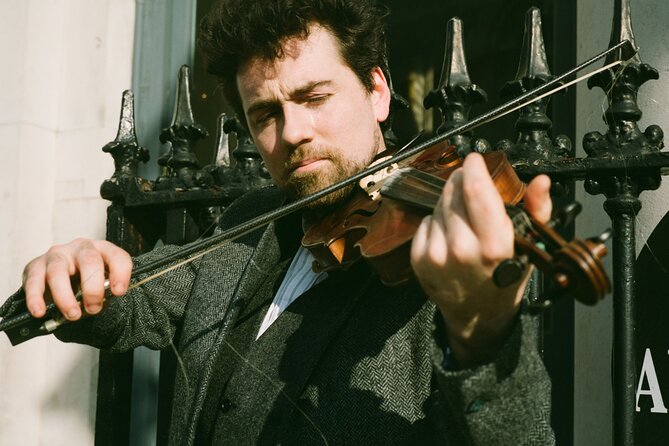
Dublin’s past sounds better with a song. This two-hour walk pairs central Dublin landmarks with live folk music, poetry, humor, and stories from Victorian times, medieval Dublin, theater, politics, and daily life. I like the way the guide uses music to explain the city rather than treating history as a list of dates. I also like the easy route from Temple Bar to Saint Patrick’s Cathedral, with short walks between stops. The main drawback is that outdoor singing can be hard to hear when traffic and street noise rise.
This is not a standard walking tour with a musician added as decoration. Guides such as Sean, Ciarán, and Dylan use guitar, mandolin, song, and sometimes dance to connect each location with Irish culture. The experience costs $27.81 per person, and the 4.9 rating from 253 reviews, with 98 percent recommending it, suggests strong value for visitors who want an entertaining introduction to Dublin.
In This Review
- Key points to know before booking
- Why music changes the way you see Dublin
- Starting at Smock Alley Theatre in Temple Bar
- Crossing the Liffey at Grattan Bridge
- Fishamble Street and Dublin’s musical past
- Christ Church Cathedral and the darker side of medieval Dublin
- Dublin Castle through Ship Street Gate
- Finishing in Saint Patrick’s Park
- The guides make or break the experience
- Group size, sound, and comfort
- Is $27.81 a fair price?
- Who should book this Dublin walk?
- Final booking advice
- FAQ
- How long is the Dublin Traditional Irish Music Walking Tour?
- Where does the tour begin?
- Where does the tour finish?
- What places does the tour visit?
- Is the tour suitable for most people?
- Can I cancel for a full refund?
Key points to know before booking
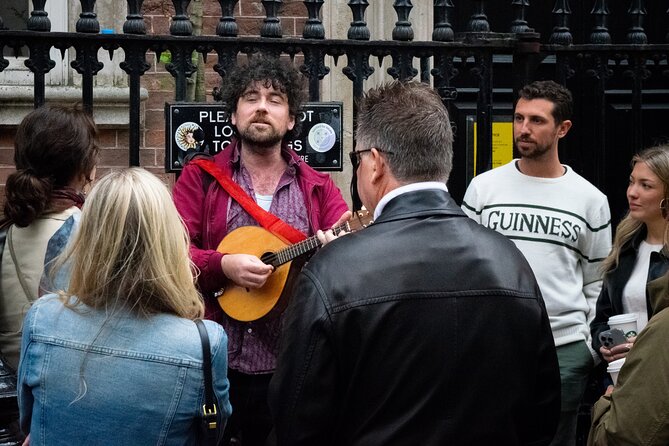
- Music carries the history: Each stop links a Dublin place with a traditional song, poem, story, or piece of Irish lore.
- A compact central route: You begin in Temple Bar and finish beside Saint Patrick’s Cathedral, passing Christ Church Cathedral, Dublin Castle, the Liffey, and several old streets.
- Guide quality matters: Sean, Ciarán, and Dylan receive especially warm praise for their singing, humor, storytelling, and ability to match a song to a location.
- Small groups are possible: The advertised maximum is 20 people, though group size can affect how well you hear the guide outdoors.
- Expect participation: You may be invited to sing or dance, but the tone is friendly and playful rather than formal.
- Plan around the start time: The tour begins at 1 p.m. at 3 Crown Alley in Temple Bar and ends at Saint Patrick’s Cathedral.
Why music changes the way you see Dublin
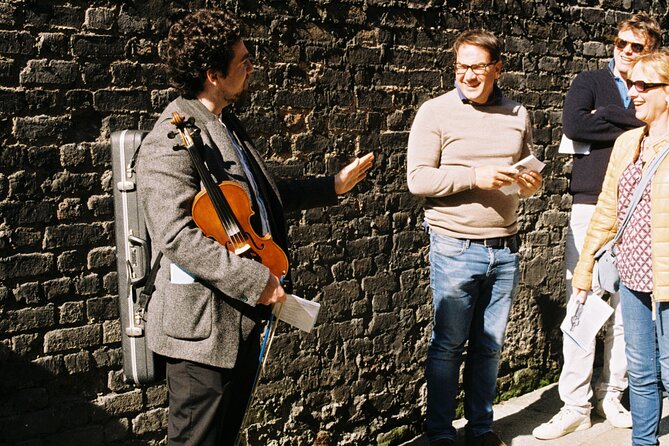
A conventional walking tour asks you to listen, look, and remember. This one adds another layer. A ballad can show how people felt about poverty, politics, religion, emigration, or city life in a way that a plaque rarely can.
I like that the songs are not random entertainment between landmarks. The guide explains the place first, then uses a song or poem to give it a human voice. You might hear a traditional piece in English, a song in Gaelic, or a familiar Dublin favorite requested on the spot. The music becomes a shortcut into Irish culture.
The format also keeps the pace lively. You are usually standing for a short talk, hearing a song, then walking a few minutes to the next stop. That rhythm is easier for many people than a two-hour lecture, especially if you are seeing Dublin early in your visit and want a broad introduction without spending the entire afternoon indoors.
The experience is also more social than a quiet sightseeing walk. You may be asked to sing along, clap, or dance. If that sounds uncomfortable, you can take part at your own level. The most appealing moments seem to come when a hesitant person relaxes and joins in, but no one should book this expecting a completely private or silent tour.
More Walking Tours in Dublin
- Dublin Highlights and Hidden Gems Guided Walking Tour
★ 5.0 · 6,020 reviews - Dublin: Highlights and Hidden Gems Walking Tour
★ 4.9 · 2,140 reviews - 1916 Rebellion Walking Tour
★ 5.0 · 1,605 reviews
Starting at Smock Alley Theatre in Temple Bar
Meet at 3 Crown Alley, in the center of Temple Bar, for the 1 p.m. start. This is a practical meeting point, but Temple Bar has many streets, pubs, and tour groups, so arrive early enough to identify the correct guide and group.
The first stop is Smock Alley Theatre 1662, described as Ireland’s oldest theater. The theater’s setting in Temple Bar gives the guide a natural opening to talk about performance, public entertainment, and the role of music and theater in Dublin life.
You spend about 10 minutes here, and admission is free as part of the walk. Do not expect a full theater visit. The value is the setting and the story, followed by a musical performance that helps explain why this part of the city has long been linked with entertainment.
One practical warning matters here: different tours can meet in the same area. One person joined the wrong historical walk and missed the music portion. Listen for the musician and confirm that your group is the traditional Irish music tour before leaving Crown Alley.
Crossing the Liffey at Grattan Bridge
From Temple Bar, the route heads toward Grattan Bridge. This is one of Dublin’s most attractive crossings, with seahorse-shaped lanterns and views along the River Liffey. It links Capel Street with Parliament Street, so you get a quick look at two different sides of central Dublin.
The guide spends roughly 10 minutes here. The bridge is more than a photo stop because its position helps you understand Dublin’s basic layout. You are moving between the old entertainment district, the river, and streets that have long carried people and commerce across the city.
This is also one of the places where sound can be unpredictable. The guide may be singing outside, with traffic, bicycles, and passing pedestrians nearby. Stay close enough to hear, especially if your group reaches the full advertised limit of 20 people.
The bridge offers some of the best quick photographs on the route. You can capture the river, the lanterns, the surrounding streets, and the changing mix of old facades and modern city activity without adding a separate sightseeing stop to your day.
Fishamble Street and Dublin’s musical past
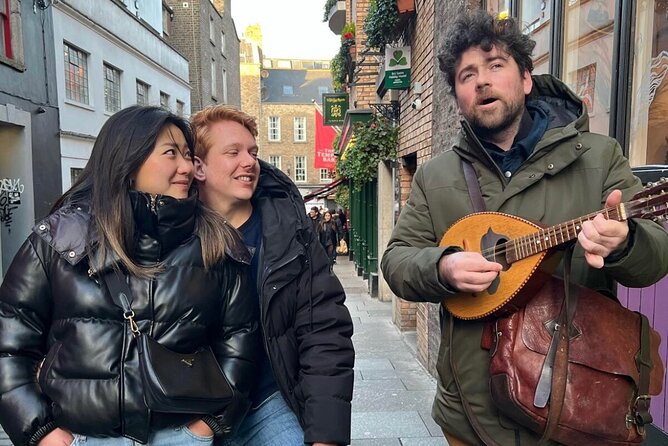
Fishamble Street is often called Dublin’s oldest street. The area was once home to a major Viking settlement, said to be the largest found outside Scandinavia, and it later became famous as the site of the first performance of Handel’s Messiah.
That is a remarkable musical connection for a street that can be easy to pass without noticing. The guide uses it to show that Dublin’s musical story includes much more than pub sessions and popular folk songs. Sacred music, theater, public performance, and street life all belong to the same story.
Again, the stop lasts about 10 minutes. I like the way the tour makes ordinary-looking streets worth a second glance. You may not spend long at any one site, but you leave with a reason to remember it.
This section should suit people who enjoy context more than checklist sightseeing. If you only want interior visits and long photo breaks, the brief outdoor format may feel light. If you enjoy hearing why a street matters, the musical connection gives Fishamble Street extra weight.
More Irish music shows:
- The Irish Dance Party in Dublin
★ 5.0 · 918 reviews - Dublin: Irish Music and Dance Show with Dance Lesson
★ 4.7 · 567 reviews - Dublin: Irish Music Walking Tour with Live Performance
★ 4.8 · 137 reviews - Galway: Trad on the Prom Ticket with Irish Music and Dancing
★ 4.9 · 482 reviews
Christ Church Cathedral and the darker side of medieval Dublin
Christ Church Cathedral is the heart of medieval Dublin, and it is one of the major visual highlights of the route. The cathedral’s medieval and Victorian elements provide a striking setting for stories about religion, power, death, and the less cheerful side of the city’s past.
The tour explores some of the cathedral and nearby area through song. The exact amount of interior access is not presented as a full cathedral visit, so you should not book this walk as a substitute for a dedicated cathedral admission. Instead, think of the stop as a musical and historical introduction to the site.
The darker stories are a good fit for traditional ballads, which often deal with loss, conflict, hardship, and injustice. A song can make these subjects feel less abstract. The guide’s performance gives the stop a mood that a standard explanation might not create.
Christ Church is also a useful orientation point. From here, you are close to Dublin Castle and several other major sights. If you plan to explore the cathedral properly, check how much time you have before or after the tour, since the walking experience itself continues after a short stop.
Dublin Castle through Ship Street Gate
The route passes Dublin Castle at Ship Street Gate, near some of the city’s most photographed steps. You do not spend the afternoon touring the castle rooms. Instead, you get a brief look at the exterior and hear how the site fits into Dublin’s political and social story.
This stop works well in the musical format because songs often preserve the feelings of ordinary people toward authority. The guide can connect a place of government with the voices of people who lived under changing political conditions.
The castle stop is another reminder that this tour is about connections. It links buildings with songs, streets with poems, and historical events with the people who remembered them. You get less architectural detail than on a specialist castle tour, but more cultural framing than you would receive from a quick photograph outside the gate.
The steps also provide a useful photo opportunity. Keep in mind that the group is moving through public streets, so the guide may need to position everyone quickly and keep the route moving.
Finishing in Saint Patrick’s Park
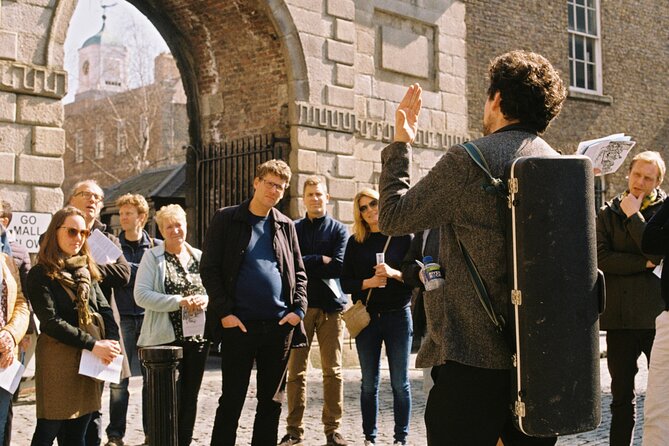
The walk ends at Saint Patrick’s Park, beside Saint Patrick’s Cathedral on Saint Patrick’s Close. This is a pleasant place to finish, with the cathedral as the final major sight and a calmer setting for the last song, story, or group moment.
Ending here is convenient. You can continue to the cathedral, pause in the park, or use the location as a starting point for more sightseeing in central Dublin. The tour does not return you to Temple Bar, so factor that into your plans if you need to collect luggage or meet someone there.
Saint Patrick’s Cathedral gives the route a strong finish. You have moved from theater and the river through old streets, medieval Dublin, and Dublin Castle, then arrived at one of the city’s best-known religious buildings. The route covers plenty of ground without becoming a long march.
The final portion may include more audience participation. The tone is light, and people who began quietly may find themselves singing or dancing by the end. That change is part of the appeal, though it also confirms that this is an entertainment-focused experience rather than a formal academic tour.
The guides make or break the experience
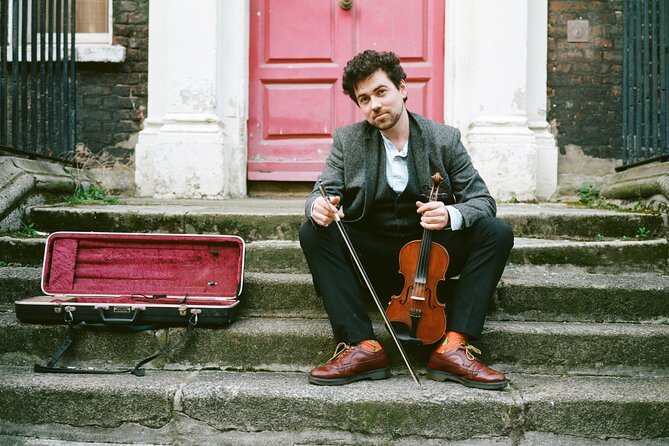
The guide is the central attraction. A good city guide can explain a site. A good musician can perform a song. This experience needs someone who can do both while keeping a group engaged on a noisy public street.
Sean receives praise for his singing, mandolin playing, humor, historical explanations, and practical recommendations for pubs and restaurants. Ciarán is praised for his showmanship, poetry, humor, and ability to make even a reluctant participant laugh and dance. Dylan is noted for explaining the background of each song before performing it, including a song in Gaelic.
The guide lineup may vary, so you cannot guarantee a particular performer. That is worth understanding before booking. The positive experiences depend heavily on the guide’s energy and ability to balance performance with explanation.
There is also a practical guide issue. One poor experience involved a late start and a small group, which made the beginning feel uncertain. Another person joined the wrong tour and missed the music. Arrive early, confirm the tour name, and stay near the guide at each stop.
Group size, sound, and comfort
The maximum group size is 20 people. That is manageable for a walking tour, but it is not the same as a private outing. You may need to stand close to hear the stories and songs, particularly beside the Liffey or on streets with traffic.
One account involved a group of about 21 people and difficulty hearing the guide. Even when the official limit is followed, public noise can still interfere. If you have hearing concerns, position yourself near the musician and ask the guide to repeat anything you miss.
Most people can participate, and service animals are allowed. The tour is near public transportation, which makes the central start and finish easy to reach, though the provided details do not specify a particular bus, tram, or rail stop.
Wear shoes suitable for city walking. The route is only about two hours and includes short stretches between stops, but you will be standing outdoors at several locations. The tour is not described as wheelchair-specific, so anyone needing detailed accessibility information should confirm conditions before booking.
Is $27.81 a fair price?
At $27.81 per person, this is a reasonable price for a two-hour experience that combines guiding and live performance. You are not only paying to be led between landmarks. You are also getting a musician who prepares songs, connects them to the locations, and handles the social side of a group performance.
The value is strongest if you would otherwise pay for both a basic walking tour and an evening of Irish music. This does not replace a full pub music session or a detailed cathedral visit, but it gives you a taste of both Dublin’s cultural story and its musical traditions in one compact outing.
The price is less convincing if you dislike audience participation or want long explanations at each site. The stops are brief, and some of the experience depends on the guide’s delivery. Still, the high rating of 4.9 from 253 ratings and the 98 percent recommendation rate point to a consistently well-liked format.
The tour is often booked about 32 days ahead. That does not mean you must reserve a month out, but it does suggest that advance planning is sensible during busy periods. Free cancellation is available until 24 hours before the 1 p.m. start time. Cancellations within 24 hours are not refunded.
Who should book this Dublin walk?
I would recommend it to first-time visitors who want a fast introduction to central Dublin with more personality than a standard sightseeing route. It also suits people who already like Irish folk music and want to understand how songs connect with places, politics, theater, religion, and everyday life.
It is a particularly good choice for couples, families with older children, and small groups of friends who enjoy shared experiences. You do not need to know Irish music in advance. The guide explains the song before performing it, so the meaning does not get lost.
You may want something else if your priority is a detailed architectural tour, a long cathedral visit, or a quiet walk with little interaction. The music is the point, and the public setting means the sound and energy can vary.
Final booking advice
Book this tour if you want Dublin explained through songs, stories, and local performance, and if you are happy to take part a little. The route covers several major sights, the price is fair, and the best guides bring real charm and musical skill.
Before the start, confirm that you are with the music tour, arrive early at 3 Crown Alley, and stay close enough to hear. If you want to visit Christ Church Cathedral or Saint Patrick’s Cathedral inside, plan extra time outside the two-hour walk. For an entertaining cultural introduction to Dublin, this is a strong choice.
FAQ
How long is the Dublin Traditional Irish Music Walking Tour?
The tour lasts approximately two hours.
Where does the tour begin?
It begins at 3 Crown Alley in Temple Bar, Dublin, at 1 p.m.
Where does the tour finish?
The tour finishes at Saint Patrick’s Cathedral, Saint Patrick’s Close, Dublin.
What places does the tour visit?
The route includes Smock Alley Theatre 1662, Grattan Bridge, Fishamble Street, Christ Church Cathedral, Dublin Castle at Ship Street Gate, and Saint Patrick’s Park beside Saint Patrick’s Cathedral.
Is the tour suitable for most people?
Most people can participate. The experience is near public transportation, and service animals are allowed. The group size has a maximum of 20 people.
Can I cancel for a full refund?
Yes. You can cancel at least 24 hours before the start time for a full refund. Cancellations or changes made within 24 hours are not refunded.
Just added around Dublin
- A Self Guided Walking Tour of Dublin’s Docklands★ 4.5 · 3 reviews
- Waterford Crystal and Kilkenny Full-Day Rail Tour from Dublin★ 5.0 · 3 reviews
- Secret and unusual Dublin: guided walking tour★ 5.0 · 3 reviews
- Turtle Bunbury’s Dublin: A Self-Guided Audio Tour from a Celebrated Author★ 5.0 · 3 reviews
- Cliffs of Moher and The Burren Private Tour from Dublin★ 5.0 · 3 reviews
- Skip-the-line St. Patrick’s Cathedral and Dublin City Tour★ 5.0 · 3 reviews
- Dublin Full-Day Tour through Boyne Valley★ 5.0 · 3 reviews
- Rock Of Cashel And Blarney Castle Private Chauffeur Full Day Sightseeing Tour★ 4.5 · 3 reviews
Irish Dance & Music Shows, compared.


Trad on the Prom Ticket with Irish Music and Dancing
Read our review →

Browse the lists this tour appears in