
Reviewed · TICKETS
Craggaunowen Admission Ticket
Step back before the castle. Craggaunowen makes Ireland’s early past feel close at hand, with reconstructed Bronze Age dwellings, a Celtic ring fort, a crannog, and a restored 16th-century castle. I like the freedom to walk at my own pace, and I like the mix of hands-on displays, open-air history, animals, and lake views. The main consideration is that this is a self-guided visit, so you get less explanation than you would on a formal guided tour.
I also like the modest $15.38 admission price, especially if you have two hours to spare near Shannon. Staff and costumed interpreters add useful context, and one visitor had a memorable encounter with a performer playing the uilleann pipes. Allow extra time if you want a relaxed walk, a stop at the farmhouse tea-room, or a closer look at every small craft display.
In This Review
- Five details that make Craggaunowen worth your time
- Why Craggaunowen works so well near Shannon
- Start with the Bronze Age crannog
- See Celtic daily life inside the ring fort
- Meet the Brendan Boat and its Atlantic story
- Climb toward Craggaunowen Castle
- Find the old roadway and the souterrain
- Meet the animals and slow down outdoors
- How to plan your visit
- Who will enjoy Craggaunowen most
- Is the $15.38 ticket good value?
- Should you book Craggaunowen?
- FAQ
- How long does a visit to Craggaunowen take?
- What is included in the admission ticket?
- Are food and drinks included?
- Is the visit guided?
- Where does the experience start and finish?
- What are the opening hours?
- Can children visit Craggaunowen?
- Are service animals allowed?
- Can I cancel for a refund?
Five details that make Craggaunowen worth your time
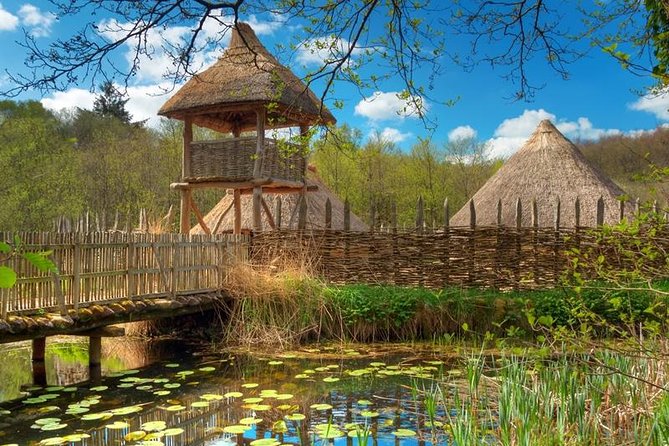
- A crannog with a concealed water path: See how an artificial island dwelling could offer both shelter and defense.
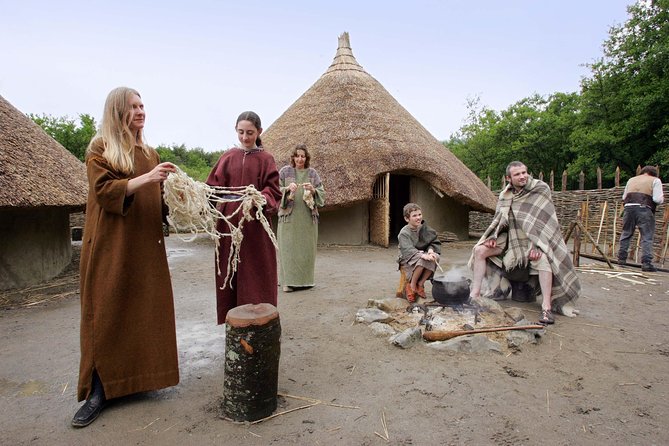
- A Celtic ring fort: Watch everyday tasks take shape through open-fire cooking, grain grinding, pottery, and woodworking.
- The Brendan Boat: View Tim Severin’s leather-hulled vessel, built for his Atlantic re-creation of St. Brendan’s voyage.
- A 16th-century castle above the lake: Craggaunowen Castle adds medieval drama and broad countryside views to the prehistoric displays.
- Animals and old trackways: Look for wild boar and Soay sheep, then explore the tog her roadway and a food-storage souterrain.
- An easy independent visit: The site usually takes about one to two hours and ends where you began.
Why Craggaunowen works so well near Shannon
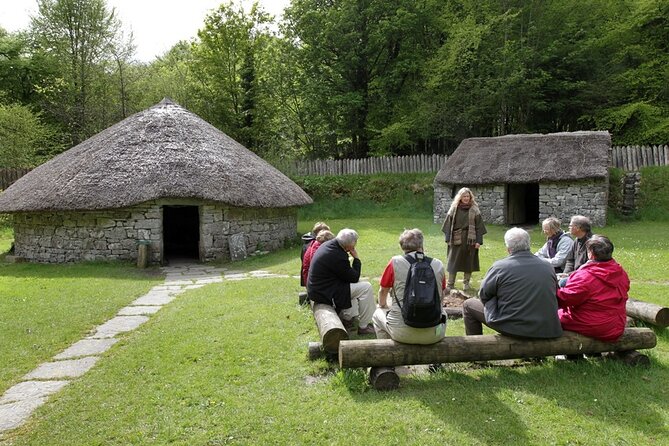
Craggaunowen is at Craggaunowen Castle and Crannóg, Kilmurry, County Clare, roughly within the orbit of Shannon sightseeing. It is a useful stop for a day built around County Clare, and it can also break up a drive between Shannon and Dublin. One person made that exact kind of stop and found that the extra couple of hours were well spent.
The appeal is not a long lecture or a tightly timed group program. You walk through a series of reconstructed places and displays that show how people lived, cooked, traveled, worked, and defended themselves. That approach gives you room to pause at the parts that catch your attention and move on from displays that interest you less.
The visit is listed at about one to two hours, with two hours a sensible target. You can move quickly through the grounds, but that would mean missing the small details: the cooking methods, hand-powered querns, pottery, wooden vessels, animal enclosures, and the unusual boat outside the main historic structures.
Admission costs $15.38 per person, including taxes, fees, and handling charges. Food and drinks cost extra. For the price, I see good value if you enjoy open-air history and want more than a single building. You get the full collection of displays, a castle, outdoor paths, reconstructed settlements, and rural views in one stop.
A few more trips worth weighing up
- Shannon Airport to Galway City, Private Chauffeur Service
★ 5.0 · 21 reviews - Celtic Dance Party
★ 5.0 · 15 reviews - Shannon Airport to Cork, Private Chauffeur Service
★ 5.0 · 9 reviews
Start with the Bronze Age crannog
The crannog is one of the most distinctive parts of the visit. A crannog is an artificial island dwelling, and this one is presented as a defended home reached by a pathway that stays hidden in the water. The setting helps you understand why people chose such a difficult place to build and live.
Look beyond the appearance of the round timber structure. The important idea is adaptation. Water offered protection, but daily life on an island brought its own problems. Food, tools, fire, and shelter all had to be managed with care. Craggaunowen lets you think through those practical demands instead of treating the Bronze Age as a collection of dates and labels.
This is a strong first stop for families because the setting gives children a clear question to answer: how would you get in, and how would you keep unwanted visitors out? The hidden route also adds a little mystery without turning the place into a theme park.
The crannog is reconstructed, so you are not looking at an untouched ancient settlement. That is worth keeping in mind. Its value is as a careful way to picture life and building methods from the past, not as an original Bronze Age home.
See Celtic daily life inside the ring fort
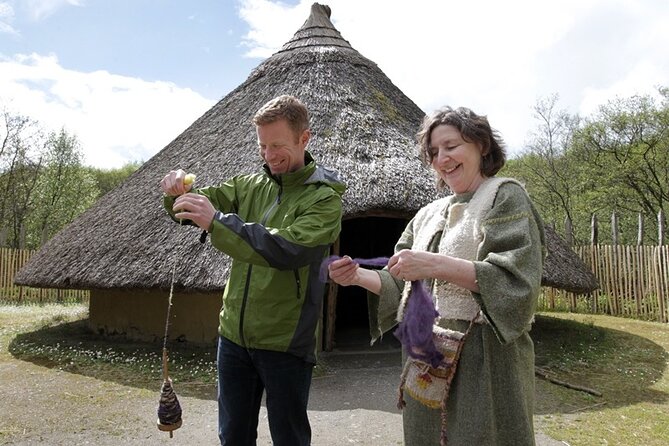
The ring fort shifts the focus from defense to routine. Here you can picture hunters and families carrying out ordinary work: cooking over open fires, preparing grain, making bread or porridge, and producing useful household objects.
The cooking display is especially memorable. Celtic hunters working far into the forest needed a way to feed large groups, and the site explains a technique using a large pit, a length of rope, and fresh meat. It is a simple reminder that outdoor cooking required planning, not just a pot over a flame.
Inside the ring fort, look for the hand-powered querns used to grind corn. The action is easy to understand, but it also shows how much labor went into a basic meal. Bread and porridge begin with grain, yet turning grain into food takes time, strength, and the right tool.
Pottery and wooden objects add another useful layer. Bowls, goblets, and platters were not merely decoration. They were part of eating, storing, serving, and sharing food. I like this section because it puts everyday work at the center. Large historical events can feel distant, but everyone understands cooking, grinding, carrying, and making things by hand.
Costumed interpreters may be working in the village when you visit. The strongest personal praise has gone to the people explaining the site, particularly the friendly staff at the entrance and the performer who played the uilleann pipes. If an interpreter is available, take a moment to ask a question. This is where the visit gains the most extra color.
Meet the Brendan Boat and its Atlantic story
The Brendan Boat is a striking change of pace. It is a leather-hulled boat built by Tim Severin for his attempt to re-create the voyage associated with St. Brendan and the early Christian monks. The voyage crossed the mid-Atlantic and explored the old claim that Brendan’s journey may have reached America centuries before Columbus.
You do not need to settle the historical debate to appreciate the boat. Its main value is practical. A leather hull makes the idea of an Atlantic crossing feel bold, uncomfortable, and very real. It also shows how experimental archaeology can test old accounts by trying to build and sail a vessel with period methods.
The boat gives the site a link between early Irish legend, Christian tradition, and seafaring. That makes it more than another object to photograph. You can consider how stories travel, how people read old texts, and how a modern sailor tried to test an ancient account with his own hands.
If you have children with you, this is a good place to ask what a boat needs for a long voyage. If you are visiting alone, pause for a few minutes and look at the construction. The boat is one of the details that makes Craggaunowen feel broader than a standard castle visit.
A completely different kind of day out from Ireland:
- Dublin to Cliffs of Moher, including Wild Atlantic Way and Galway
★ 5.0 · 23,331 reviews - From Dublin: Cliffs of Moher, Burren & Galway City Day Tour
★ 4.8 · 18,888 reviews - Dublin: Guinness Storehouse Entry Ticket
★ 4.6 · 16,863 reviews - Dublin to Cliffs of Moher, Burren, Wild Atlantic Way, Galway Tour
★ 5.0 · 12,924 reviews
Climb toward Craggaunowen Castle
Craggaunowen Castle dates to 1550 and was restored as a medieval castle. It sits on a crag above the lake, giving you a change in scale after the smaller prehistoric homes and craft displays.
The castle is valuable for two reasons. First, it gives you a clear medieval contrast. The ring fort and crannog focus on earlier forms of settlement, while the castle shows a later world of stone, height, status, and defense. Second, its position opens up views of the surrounding countryside and lake.
Do not rush through this portion. The castle adds atmosphere, but the view is part of the experience too. After looking at compact homes and enclosed forts, you get a wider sense of the rural setting that connects all the displays.
The restored nature of the building means it should be approached as an interpretation of a 16th-century castle rather than a perfectly preserved medieval interior. That is not a serious weakness, but it helps set expectations. The outdoor collection and reconstructed settlements are the main reason to come.
Find the old roadway and the souterrain
Craggaunowen also includes a tog her, one of Ireland’s early roadways, dated to 148 BC. This type of wooden trackway gives you a direct sense of movement across wet ground. It is a small feature, but it helps explain how people traveled through difficult terrain before modern roads.
The souterrain is another favorite for anyone who enjoys tight, atmospheric spaces. It was designed to store food, but it could also serve as an escape route during an attack. That double use tells you something about life in an uncertain period. A place built for storage might also need to protect people.
The souterrain is fun to explore, though you should pay attention to the physical nature of the visit. It is not a polished museum gallery. The appeal comes from imagining how a practical food store could become a hiding place or route out of danger.
Together, the tog her and souterrain keep the visit from becoming a series of isolated buildings. They show the larger system around a settlement: how people moved, stored food, and responded to threats.
Meet the animals and slow down outdoors
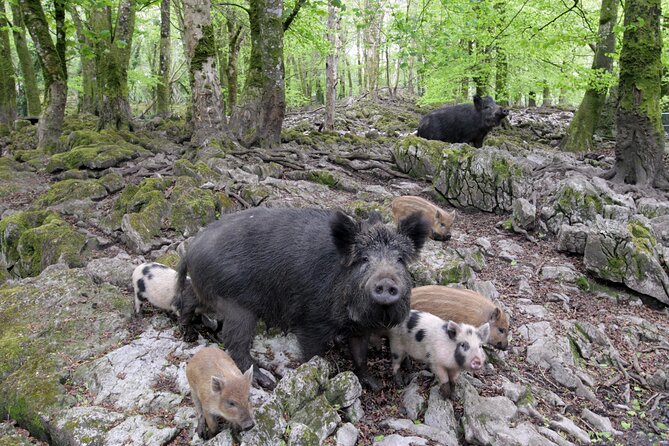
The site includes rare animal breeds such as wild boar and Soay sheep, described as examples connected with prehistoric life. You may also see donkeys and ponies near the entrance, where yellow iris fields add a cheerful welcome.
The animals are not the central reason to visit, but they help younger children stay interested while adults read the displays. They also give the prehistoric sections a more grounded feel. Farming, food, transport, and animal care were part of life, not side notes.
The lake walks and fresh air are another reason not to treat Craggaunowen as a quick indoor stop. You can walk at an easy pace and enjoy the rural setting between the historic structures. If weather is good, the outdoor space makes the admission feel more worthwhile.
There is a farmhouse tea-room for homemade food, but food and drinks are not included in the ticket. That is useful to know before you arrive. Plan to pay separately if you want a meal or refreshment, and do not assume the admission price covers anything beyond the site itself.
How to plan your visit
The listed opening hours are 10 a.m. to 5 p.m., Monday through Sunday, for the stated operating period of May 5 through September 3, 2026. Check the date and hours when making plans, especially if your schedule depends on a narrow arrival window.
A mobile ticket is offered, and confirmation is provided at booking. The experience is in English and begins and ends at Craggaunowen Castle and Crannóg. You do not join a scheduled coach circuit. Instead, you explore the grounds independently.
The activity information lists a maximum of one traveler. That is unusual for an admission ticket, so I would confirm the booking details if you are arranging a larger party. Children must be accompanied by an adult, and service animals are allowed.
The site is near public transportation, and most people can participate. The supplied details do not describe specific paths, slopes, or interior access, so anyone with mobility concerns should ask for current practical information before booking.
Plan on two hours if you want to see the crannog, ring fort, Brendan Boat, castle, roadway, souterrain, animals, and outdoor paths without hurrying. One hour is possible, but it will feel like a brisk survey.
Who will enjoy Craggaunowen most
I would recommend this stop to independent visitors who like to read, look around, and set their own pace. It suits families because the crannog, souterrain, animals, and cooking demonstrations give children concrete things to see.
It also works well for anyone driving between major stops in Ireland. The visit is long enough to feel worthwhile but short enough to fit into a larger County Clare plan. If you are leaving Shannon and heading east toward Dublin, it can make a useful historical break.
You may want to choose something else if you need a formal tour with a fixed narrative and continuous explanation. The interpreters can add excellent detail, but they may not be stationed at every exhibit. The experience depends partly on how much you choose to stop, read, and ask.
History enthusiasts will find plenty to enjoy, but you do not need specialist knowledge. The displays explain broad ideas through homes, tools, food, roads, boats, and animals. That makes the site approachable without making it childish.
Is the $15.38 ticket good value?
At $15.38, the admission is fairly priced for a two-hour visit that combines several different types of attraction. You are not paying only to enter a castle. You are also getting the crannog, ring fort, boat, roadway, souterrain, animal displays, lake walks, and access to all exhibits.
The value improves if you use the full two hours and speak with the interpreters. It is less compelling if you rush in, take a few pictures, and leave after 45 minutes. I would also factor in the tea-room separately, since refreshments are not part of the ticket.
Free cancellation is allowed up to 24 hours before the start time for a full refund. Cancellations or changes made less than 24 hours ahead are not refunded or accepted, and the cut-off follows local time. That gives you useful flexibility while planning an Ireland road trip, but only if you make changes early.
Should you book Craggaunowen?
Book it if you want a relaxed, self-guided look at early Irish life with enough variety to keep a two-hour stop interesting. The crannog, ring fort, and Brendan Boat are the strongest features, while the castle and lake views add welcome variety.
I would especially choose Craggaunowen for a County Clare driving day, a family outing, or anyone curious about how people cooked, traveled, built homes, and protected food long ago. Skip it only if you want a major surviving monument with a long guided presentation. For an independent visit at a reasonable price, Craggaunowen earns its place on your route.
FAQ
How long does a visit to Craggaunowen take?
The visit takes approximately one to two hours. Allow closer to two hours if you want to see every display, walk around the grounds, visit the animals, and enjoy the rural setting at an easy pace.
What is included in the admission ticket?
The ticket includes admission to Craggaunowen, access to all displays and exhibits, and all taxes, fees, and handling charges.
Are food and drinks included?
No. Food and drinks are not included in the admission price. The site has a farmhouse tea-room where you can purchase homemade fare separately.
Is the visit guided?
The experience is self-guided and offered in English. Interpreters may be present in the reconstructed village to provide additional information.
Where does the experience start and finish?
It starts at Craggaunowen Castle and Crannóg in Kilmurry, County Clare, and ends back at the same meeting point.
What are the opening hours?
The listed hours are 10 a.m. to 5 p.m., Monday through Sunday, during the stated operating period from May 5 through September 3, 2026.
Can children visit Craggaunowen?
Yes. Children must be accompanied by an adult.
Are service animals allowed?
Yes. Service animals are allowed.
Can I cancel for a refund?
Yes, you can cancel up to 24 hours before the experience start time for a full refund. Cancellations or changes made less than 24 hours before the start time are not accepted, and the amount paid is not refunded.
Just added around Ireland
- Cork Chat and History Walking Tour★ 5.0 · 3 reviews
- A Self Guided Walking Tour of Dublin’s Docklands★ 4.5 · 3 reviews
- Galway’s Historical Gems: A Walk Through Time★ 5.0 · 3 reviews
- From Dublin: 3-Day Dingle, Killarney & the Wild Atlantic Way★ 5.0 · 3 reviews
- Fastnet Rock Lighthouse direct boat tour-Baltimore.Guided.★ 3.7 · 3 reviews
- Cork Private Walking Tour★ 5.0 · 3 reviews
- Cork Private Transfer from Cork Airport to City centre★ 5.0 · 3 reviews
- Waterford Crystal and Kilkenny Full-Day Rail Tour from Dublin★ 5.0 · 3 reviews
Tickets, compared.


Fast-Track Book of Kells Ticket & Dublin Castle Tour
Read our review →
The Dublin Pass with Tickets to 40+ Attractions
Read our review →
Christ Church Cathedral Entrance Ticket & Self-Guided Tour
Read our review →
Smithwick’s Experience Kilkenny Entrance Ticket
Read our review →
Go City: Dublin Pass | Save up to 50% – Includes 35+ Things To Do
Read our review →Browse the lists this tour appears in