
Reviewed · HISTORICAL TOURS
2-Hour Historical Walking Tour from Dublin
Dublin’s past is hiding in plain sight. This two-hour walking tour links Trinity College, Temple Bar, Viking Dublin, Christ Church Cathedral, and Dublin Castle into one clear story. I like the low $22.98 price, and I love that the guides are history postgraduates who can explain why these places matter, not just point at them.
The group is capped at 25, which keeps the cost down while still giving you a fair chance to hear the guide. The main caution is the amount of political and historical detail. If you prefer a light introduction centered on cafés, local life, and pretty buildings, this can feel dense. It may also run beyond two hours, so avoid booking it immediately before a timed attraction.
In This Review
- Key points to know before you go
- Why this short walk makes a smart first Dublin activity
- Meeting at Trinity College and entering Ireland’s oldest university
- Bank of Ireland and the architecture of political power
- Temple Bar beyond the pub district
- Wood Quay and the Viking city beneath Dublin
- Four Courts and the split that began the Civil War
- Christ Church Cathedral and the medieval invasion
- City Hall and Daniel O’Connell’s campaign
- Dublin Castle and the name Dubh Linn
- The guide style, pace, and amount of detail
- Is $22.98 good value?
- Who should book this Dublin history walk?
- Should you book it?
- FAQ
- How long does the Dublin historical walking tour last?
- Where does the tour begin?
- Where does the tour end?
- Is entry to the Book of Kells included?
- How many people can join the tour?
- Is the tour offered in English?
- Can I cancel for a full refund?
Key points to know before you go
- Begin opposite Trinity College: Meet at the Henry Grattan Monument on College Green, across from the front gate, not at the college gates themselves.
- Follow Dublin across 5,000 years: The route moves from ancient foundations and Viking settlement to the Irish Civil War, independence, and modern politics.
- Expect a serious history lesson: The guides are history postgraduates, and names such as Eoin, Jody, John, Daragh, Caolan, and Colm have been praised for clear, lively storytelling.
- The Book of Kells is explained, not included: You enter the Trinity campus, but admission to the Book of Kells is not part of the tour.
- Allow more than two hours if needed: The advertised duration is about two hours, though some guides continue for roughly two and a half hours.
- Wear sensible shoes and check the forecast: You will walk through central Dublin in all weather, with no indoor shelter guaranteed at every stop.
Why this short walk makes a smart first Dublin activity
Dublin can be easy to walk through and surprisingly hard to understand. A Georgian parliament, a Viking excavation, a medieval cathedral, and a former British administrative center all sit within a fairly compact central area, but the connections are not always obvious when you see them one by one.
This tour gives you those connections early in your visit. You start near Trinity College and finish at Christ Church Cathedral, covering the south side of the Liffey and the old civic core. That makes it useful for getting your bearings, too. Afterward, you can return to the places that caught your interest, such as the Book of Kells, Dublin Castle, or the cathedral.
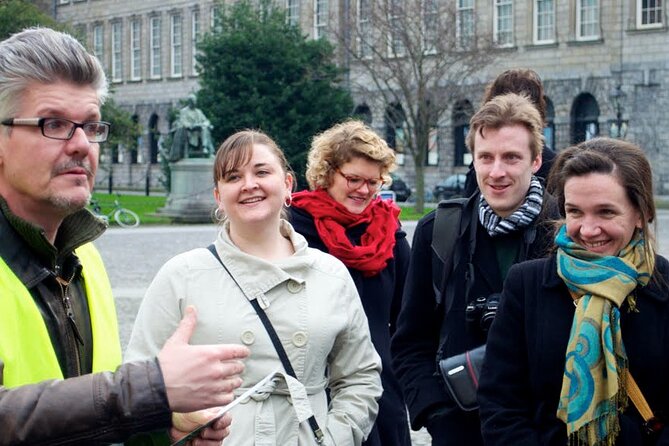
The guide is the main reason to book. Historical Walking Tours of Dublin uses history postgraduates, so the presentation goes beyond dates and royal names. The strongest guides combine political context with small stories, jokes, songs, and clear explanations of how events affected Dublin’s buildings and people.
That depth is also the tour’s main weakness. You may hear about several thousand years of Irish history in a single morning. One guide reportedly opened with 5,000 years in five minutes, then added detail at each stop. That is useful if you want context, but you need to pay attention. Younger children may lose interest, while a history-loving teenager could have a great time.
More Historical Tours in Dublin
- Dublin Historical Centre Food Tour with 8 Food Tastings & Drinks
★ 5.0 · 1,718 reviews - Historical 2-Hour Guided Walking Tour of Dublin
★ 4.7 · 865 reviews - Dublin to Cork, Blarney Castle & Cóbh Heritage Centre by train
★ 4.5 · 510 reviews
Meeting at Trinity College and entering Ireland’s oldest university
The meeting point is the Henry Grattan Monument on College Green, opposite Trinity College’s front gate. This detail matters. Do not wait at the gates themselves. A past mix-up happened when someone followed an inaccurate map and missed the guide, so check that your directions say the Grattan statue.
The group then enters the Trinity campus for about 20 minutes. Founded in 1592, Trinity is Ireland’s oldest university, and the opening talk uses the college to introduce education, religion, power, and national identity in Ireland.
The campus is also associated with the Book of Kells, an eighth-century Latin manuscript containing the four Gospels. The guide explains why it is considered Trinity’s most valuable artifact, but entry to the Book of Kells is not included. If you want to see the manuscript, plan that visit separately and account for its admission cost and time.
This first stop sets the tone. You are not simply looking at an old college courtyard. You are being shown how an institution founded during a particular religious and political era fits into Ireland’s later story.
Bank of Ireland and the architecture of political power
A short walk brings you to the Bank of Ireland, built in 1729. The building originally served as Ireland’s colonial parliament, before the Act of Union abolished that parliament in 1800.
The stop lasts about ten minutes, but the subject is large. The building represents Protestant Ascendancy, the system in which political and economic power rested heavily with a Protestant ruling class, particularly during the eighteenth century. Its Neo-Classical design reinforces the message of authority and order.
This is where the tour’s political focus becomes clear. You will hear not only what the building was used for, but what it said about who had power and who did not. That approach helps explain why later Irish politics became so charged.
The drawback is simple: if architecture is your main interest, the explanation may spend more time on parliament and religion than on columns, proportions, or decorative details.
Temple Bar beyond the pub district
Temple Bar is now one of Dublin’s best-known areas, but the tour presents a less familiar version of it. In the 1990s, the narrow-street district was marked for demolition before being repurposed as Dublin’s Cultural Quarter.
The stop takes about ten minutes. You will hear how an area that might have disappeared became a central part of Dublin’s public image. That history gives you a useful warning about city development: places that look old and inevitable may have been saved, altered, or reinvented quite recently.
Do not expect a long pub crawl here. Temple Bar is a historical pause, not a food or nightlife tour. The guide’s focus is on urban change and cultural planning. After the walk, you can return on your own if you want to explore the area’s restaurants, pubs, or cultural venues.
More Walking Tours in Dublin
- Dublin Highlights and Hidden Gems Guided Walking Tour
★ 5.0 · 6,020 reviews - Dublin: Highlights and Hidden Gems Walking Tour
★ 4.9 · 2,140 reviews - 1916 Rebellion Walking Tour
★ 5.0 · 1,605 reviews - 90 Minute Dublin Walking tour and Sightseeing tips
★ 5.0 · 916 reviews
Wood Quay and the Viking city beneath Dublin
At Wood Quay Amphitheatre, the subject shifts much further back. Extensive archaeological work in the 1980s uncovered evidence connected to the Viking city, founded around AD 840.
This ten-minute stop helps explain Dublin’s beginnings as a settlement shaped by trade, water, and movement. The site also reminds you that modern streets can sit above layers of earlier cities. You may find that the stop has more impact after the guide explains what was excavated and why it changed the understanding of Dublin’s origins.
The stop is fairly brief, so do not expect a full archaeological visit or museum presentation. Its value comes from fitting Viking Dublin into the larger sequence: ancient settlement, medieval conquest, colonial government, and the modern Irish state.
Four Courts and the split that began the Civil War
The Four Courts is one of the route’s most important political stops. Ireland’s legal headquarters became the site where the Civil War began in June 1922.
The conflict divided those who supported the Treaty of December 1921 and those who opposed it. That Treaty had ended the War of Independence from 1919 to 1921, but it also created a new political split. The guide uses the Four Courts to explain how independence did not bring instant agreement.
You spend about 20 minutes here, making it one of the longer stops. That extra time is useful because the subject can be difficult. The difference between the War of Independence, the Treaty, and the Civil War is easy to blur when you are visiting quickly. A strong guide will slow the story down and show how the dispute shaped the new state.
This is also a good example of the tour’s value. You are not only seeing a major building. You are learning why it mattered at a particular moment, and why Irish political memory still carries the effects of that division.
Christ Church Cathedral and the medieval invasion
Christ Church Cathedral is Dublin’s oldest cathedral, dating to 1030. The present stone rebuilding began in the 1170s under Strongbow, a figure linked to the original English invasion of that period.
The stop lasts about ten minutes and marks a change from modern political conflict to medieval power. The cathedral connects religious authority, English involvement, and Dublin’s position as a city that repeatedly changed hands and rulers.
Because the tour ends here, you can decide if you want to continue inside after the guide finishes. The route itself does not state that cathedral admission is included, so check separately before planning a paid visit. Even if you do not enter, the exterior and its setting help make sense once you know the story behind them.
The ending is practical, too. Christ Church is near several central sights, including City Hall and Dublin Castle, so you are well placed to continue exploring after the guide says goodbye.
City Hall and Daniel O’Connell’s campaign
City Hall brings the story to nineteenth-century reform. Inside is a statue of Daniel O’Connell, Dublin’s first Catholic Lord Mayor, elected in 1840.
O’Connell led the successful campaign for Catholic Emancipation in 1829, ending anti-Catholic laws. That achievement explains his nickname, The Liberator, and gives the tour a human figure to connect with the broader political story.
The stop is scheduled for about ten minutes. It is less about touring City Hall as a grand interior and more about understanding O’Connell’s role and the long struggle over religion and political rights.
I like this stop because it adds a personal scale to a subject that can otherwise feel abstract. You hear about laws, institutions, and religious divisions, then meet the individual associated with a major change.
Dublin Castle and the name Dubh Linn
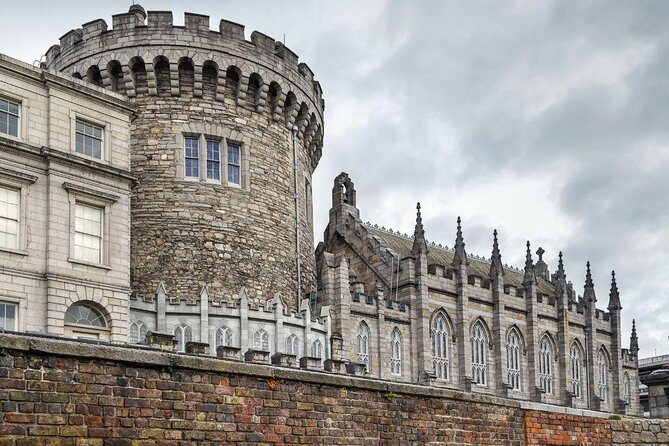
The final major stop is Dublin Castle, built by King John in 1204. It served as the seat of British administration until 1922, making it central to the story of colonial rule and Irish independence.
The castle is also linked to the Dubh Linn, or Black Pool, from which Dublin takes its name. That small piece of language gives the city a memorable origin point. You begin to see Dublin not as a collection of disconnected attractions, but as a place shaped by water, settlement, conquest, administration, and resistance.
The planned talk here lasts about ten minutes. Since the tour ends at Christ Church Cathedral, the castle is close to the finish but not the final endpoint. Keep that in mind if you are arranging transport or a timed booking afterward.
Dublin Castle can take more time on its own, so this walk works best as an introduction. You get the setting and the political background, then return later if you want a slower visit.
The guide style, pace, and amount of detail
The strongest praise is directed at the guides. Eoin is described as entertaining, easy to hear, and able to hold attention even in rainy, windy weather. Jody is praised for combining enthusiasm, acting ability, humor, and a wide grasp of Irish history. John is noted for a clear voice and a funny presentation, while Daragh, Caolan, and Colm are also singled out for friendly, engaging tours.
Specific guides are not guaranteed, so you should book for the format rather than one particular person. Still, the pattern is clear: this company places a great deal of weight on presentation, not just facts.
The tone can vary by guide, but expect a serious subject delivered with stories, jokes, and occasional songs. One guide was especially good at mixing short funny details with more serious explanations. That balance helps, though you still need to concentrate.
The walking itself is not described as difficult, but it is a full two hours on city streets. Wear comfortable shoes and dress for Dublin weather. January cold, rain, and wind have not stopped the tours, but they can affect your enjoyment. A mobile ticket makes arrival simple, and the meeting point is near public transportation.
Is $22.98 good value?
At $22.98 per person, this is an inexpensive way to spend a morning or afternoon in central Dublin. The value comes from the guide’s interpretation, since almost every stop is viewed from public spaces and admission is generally not part of the cost.
The price is especially fair if you want a broad foundation before paying for individual attractions. You can learn what interests you, then choose where to spend more time. The Book of Kells is the clearest example: the tour gives you its context, but you pay separately if you want to see it.
A group limit of 25 keeps the price below many private or small-group options. It is not an intimate one-to-one walk, but it is small enough that the guide can usually be heard if the group stays together. The experience is offered in English only, so you should be comfortable following a detailed spoken presentation.
The advertised average booking time is 21 days in advance. That suggests you should reserve ahead if your Dublin dates are fixed, especially if you want to take the walk at the beginning of your stay.
Who should book this Dublin history walk?
I would choose this tour if you want political context, major landmarks, and a fast introduction to Dublin’s long story. It suits adults, history fans, and older teenagers who can follow a detailed talk.
It is also a good fit for anyone who likes to revisit places later. The walk passes several sights you may want to explore at your own speed, and the guide helps you decide which ones deserve a return visit.
I would think twice if you want a relaxed culture walk with plenty of time for photographs. There are eight stops in roughly two hours, and the guide may have a lot to say. Families with young children may find the political detail tiring, while people who prefer a slow pace may dislike the possibility of the tour lasting longer than advertised.
The route requires a moderate level of fitness. Service animals are allowed, and the tour is near public transportation, but the supplied information does not promise step-free access at every point. If that matters to you, ask before booking.
Should you book it?
Book it if you want to understand Dublin before exploring it. The low price, central route, small maximum group, and history postgraduate guides make this a strong first-day choice.
Skip it if you mainly want entertainment, food, or a gentle architectural stroll. This is a serious history tour with jokes and stories, not a lightweight sightseeing loop. Bring comfortable shoes, prepare for weather, and meet at the Grattan statue rather than the Trinity gates. If those conditions suit you, two hours here can make the rest of your Dublin visit far easier to place.
FAQ
How long does the Dublin historical walking tour last?
The advertised duration is approximately two hours. Some tours have lasted about two and a half hours, so avoid scheduling a timed activity immediately afterward.
Where does the tour begin?
It begins at the Henry Grattan Monument on College Green, opposite the front gate of Trinity College Dublin. The correct meeting point is the statue, not the college gates.
Where does the tour end?
The stated endpoint is Christ Church Cathedral on Christchurch Place in the Wood Quay area of Dublin.
Is entry to the Book of Kells included?
No. The guide explains the Book of Kells and its importance, but entry to see it is not included.
How many people can join the tour?
The group has a maximum of 25 people.
Is the tour offered in English?
Yes. The experience is offered in English.
Can I cancel for a full refund?
Yes. You can cancel at least 24 hours before the local start time for a full refund. Cancellations or changes made less than 24 hours before the start time are not accepted for a refund.
More 2-Hour Experiences
- 2 Hour Walking Tour of Dublin’s City Centre
★ 5.0 · 63 reviews - Dublin: 2-Hour Premium Whiskey and Food Tasting Tour
★ 4.7 · 54 reviews - Dublin: 2 Hour City Center Guided Walking Tour
★ 4.9 · 12 reviews - 2-Hour Deluxe Whiskey & Food Tasting
★ 4.6 · 9 reviews
Just added around Dublin
- A Self Guided Walking Tour of Dublin’s Docklands★ 4.5 · 3 reviews
- Waterford Crystal and Kilkenny Full-Day Rail Tour from Dublin★ 5.0 · 3 reviews
- Secret and unusual Dublin: guided walking tour★ 5.0 · 3 reviews
- Turtle Bunbury’s Dublin: A Self-Guided Audio Tour from a Celebrated Author★ 5.0 · 3 reviews
- Cliffs of Moher and The Burren Private Tour from Dublin★ 5.0 · 3 reviews
- Skip-the-line St. Patrick’s Cathedral and Dublin City Tour★ 5.0 · 3 reviews
- Dublin Full-Day Tour through Boyne Valley★ 5.0 · 3 reviews
- Rock Of Cashel And Blarney Castle Private Chauffeur Full Day Sightseeing Tour★ 4.5 · 3 reviews
Historical Tours, compared.

Dublin Historical Centre Food Tour with 8 Food Tastings & Drinks
Read our review →
Historical 2-Hour Guided Walking Tour of Dublin
Read our review →
Dublin to Cork, Blarney Castle & Cóbh Heritage Centre by train
Read our review →
Jeanie Johnston Tall Ship Irish Famine History Tour
Read our review →

Deliciously Dublin: The Artisan Donut Walking & History Tour
Read our review →
Browse the lists this tour appears in