
Reviewed · WALKING TOURS
Dublin: Bucket List Sights Walking Tour
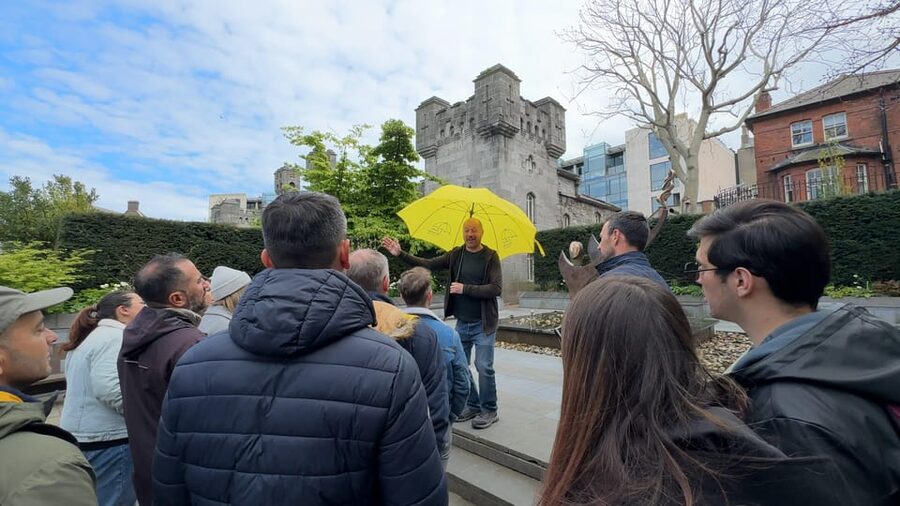
Dublin’s old center packs centuries into two hours. This $19 walking tour links the city’s major sights in a sensible route, from Viking-era Christchurch Cathedral to Trinity College, while a local guide explains how Celtic, Viking, Norman, British, and modern American influences shaped Dublin. I like the strong mix of famous landmarks and lesser-known details, especially the Viking boats at Dubh Linn and the city views from the north side. I also like that guide Peter adapts his explanations to your English level and offers tips for the rest of your stay. The main drawback is that the tour is an overview, not a full visit inside every major attraction.
You meet across from Christchurch Cathedral, outside the Bull and Castle, looking for the yellow umbrella. The route returns to the same meeting point after two hours, though the final stop is outside Trinity College. Since entrance tickets are not included, you should see this as a city orientation walk rather than a collection of interior visits. Still, at $19, it offers a useful first look at Dublin’s historic core.
In This Review
- Key points about the Dublin walking tour
- Starting beside Christchurch Cathedral
- St. Patrick’s Cathedral and Dublin’s patron saint
- Dubh Linn Garden and the Viking harbor
- Dublin Castle and the end of British rule
- Temple Bar beyond the nightlife
- Crossing the Liffey and seeing Dublin from the north
- College Green and Georgian Dublin
- Molly Malone and the final walk to Trinity College
- What the $19 price really gives you
- Who will enjoy this walk most
- Should you book the Dublin Bucket List Sights Walk?
- FAQ
- How much does the Dublin Bucket List Sights Walking Tour cost?
- How long does the tour last?
- Where does the tour begin?
- How will I find the guide?
- Where does the tour end?
- What language is the tour conducted in?
- Is the tour wheelchair accessible?
- Are admission tickets to the attractions included?
- Can I cancel the tour for a refund?
Key points about the Dublin walking tour
- Christchurch Cathedral begins the story in Viking Dublin: The cathedral site connects directly with the city’s early Norse settlement.
- Dublin Castle shows the handover of power in 1922: You explore its lower and upper courtyards and hear how British rule ended there.
- Temple Bar is more than a pub district: The guide places its modern nightlife beside its older Tudor-era origins.
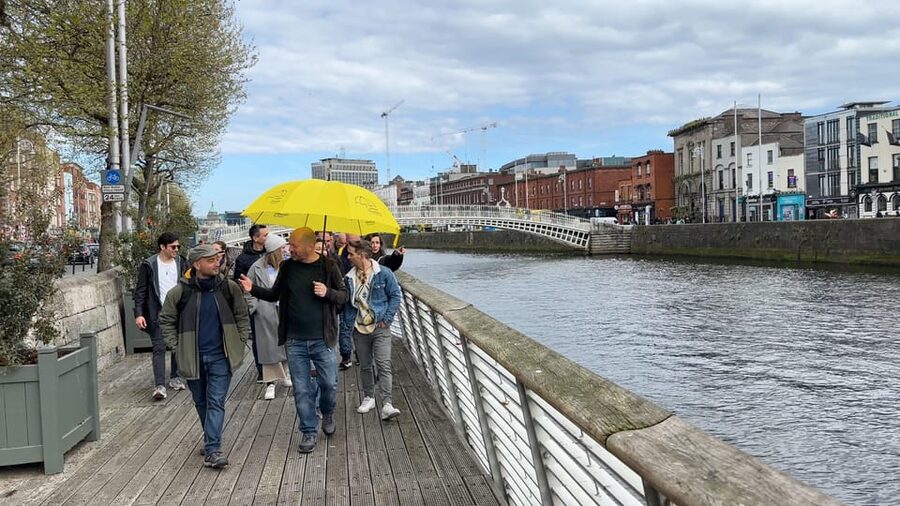
- The route crosses the River Liffey twice: Ha’Penny Bridge and the north-side viewpoint help you see Dublin as one connected city.
- Trinity College finishes the walk with the Book of Kells: You end at the front gate, ready to decide if the exhibition deserves a separate visit.
- Peter earns praise for his personal approach: He answers questions, adjusts his English, and gives practical ideas for the rest of your visit.
Starting beside Christchurch Cathedral
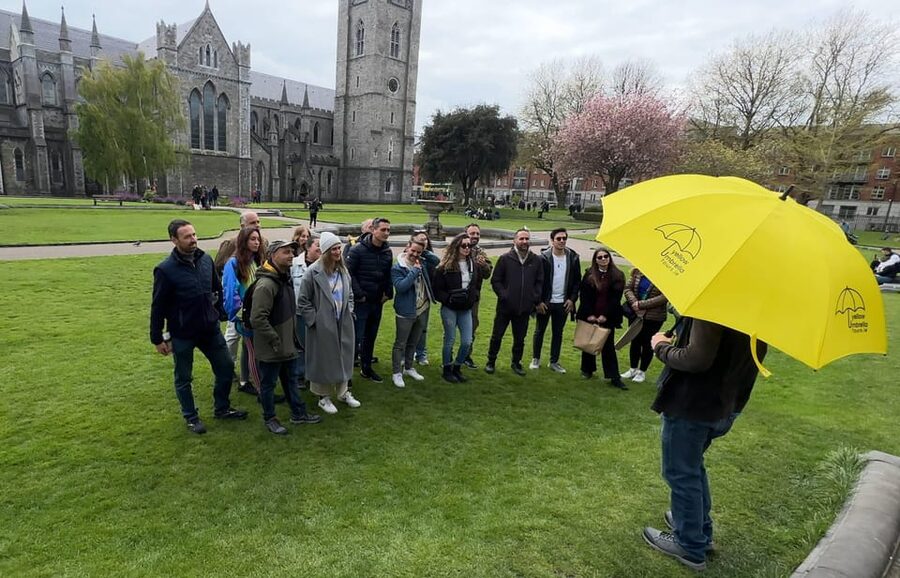
The meeting point is easy to identify: cross the road from Christchurch Cathedral and find the guide with the yellow umbrella outside the Bull and Castle. That visual marker matters in a busy old-city area, especially if you are arriving for the first time and are still sorting out Dublin’s streets.
Christchurch is a strong place to begin because it gives the tour an immediate sense of age. The site was first associated with a wooden Viking church about a thousand years ago, then rebuilt in stone by the Normans. The cathedral you see today owes much of its 19th-century neo-Gothic appearance to whiskey money from Henry Roe.
That detail is useful because it links architecture to the people and industries that paid for it. You are not only looking at pointed arches and old stone. You are hearing how wealth from Dublin’s whiskey trade helped shape the building.
The tour focuses on the outside setting and the historical story. If you want to inspect the cathedral interior, crypt, or exhibitions at length, plan a separate visit. The walking route has several more major stops, so the guide cannot give Christchurch the time of a dedicated cathedral tour.
More Walking Tours in Dublin
- Dublin Highlights and Hidden Gems Guided Walking Tour
★ 5.0 · 6,020 reviews - Dublin: Highlights and Hidden Gems Walking Tour
★ 4.9 · 2,140 reviews - 1916 Rebellion Walking Tour
★ 5.0 · 1,605 reviews
St. Patrick’s Cathedral and Dublin’s patron saint
From Christchurch, the route continues to St. Patrick’s Cathedral, the church named for Ireland’s beloved patron saint. The story of Patrick banishing snakes is part of the traditional account connected with his name, and it gives the guide a memorable way to introduce one of Ireland’s most familiar figures.
St. Patrick’s is also linked with Jonathan Swift, author of Gulliver’s Travels and a former dean of the cathedral. That connection gives the stop extra appeal if you enjoy literary history. The cathedral was restored in the 1860s through the generosity of Sir Benjamin Lee Guinness, another reminder that Dublin’s landmarks were often shaped by private fortunes.
I like this part of the route because the two cathedrals complement each other. Christchurch brings in Vikings and Normans. St. Patrick’s adds religion, literature, restoration, and national identity. In a short space, you get several different ways to understand Dublin.
Again, expect explanation rather than a long interior visit. The value here is the connection between the building, Swift, Guinness, and Irish tradition. If St. Patrick’s is high on your personal list, you may want to return after the tour and give it more time.
Dubh Linn Garden and the Viking harbor
The next stop is Dubh Linn Garden, beside Dublin Castle and the Chester Beatty Library. The name Dubh Linn means black pool, and this area is tied to the place where Viking longboats were moored when Norse settlers arrived in Dublin roughly twelve hundred years ago.
This is one of the tour’s more distinctive details. You get a physical sense of how the early settlement related to water, rather than treating Viking Dublin as a vague chapter from the past. The city’s name and its early harbor life come together in one stop.
The Chester Beatty Library is also worth noting. It is described as an outstanding cultural attraction in the garden area, but it is not a scheduled interior visit on this walk. If you have extra time in Dublin, it may be a good place to mark for later, especially if you enjoy books, manuscripts, and art from different cultures.
The tour’s early section moves quickly through major historical layers. I would listen for the links between each stop instead of trying to memorize every date. The guide’s job is to show how one part of the city led to the next.
Dublin Castle and the end of British rule
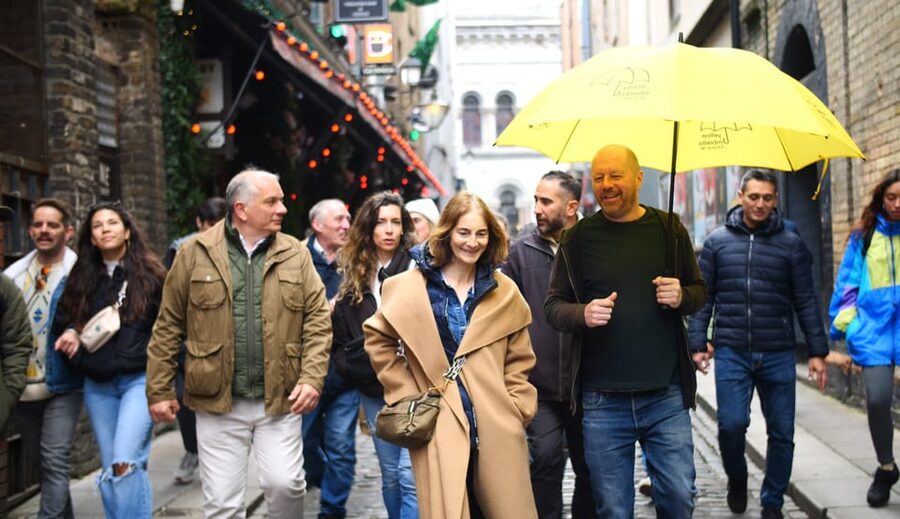
Dublin Castle gives the tour its clearest political chapter. You walk through the lower and upper courtyards and see a mix of medieval and Georgian architecture. The complex served as the center of British government in Ireland for about 700 years.
That long period makes the castle more than a handsome collection of buildings. It was the place from which British administration operated, and in 1922 it was handed over to Michael Collins and the Irish Free State after independence.
The change in power is the key point to watch for. Dublin Castle helps you connect architecture with political control, then with the creation of the modern Irish state. The courtyards also provide a break from the narrow streets and give the guide room to explain the site’s role.
The route explores both the lower and upper courtyard areas, but the tour does not promise a full castle interior visit. If you want state rooms or a more detailed look at the complex, check the castle separately. For a two-hour city walk, the castle stop gives you an effective outline without turning the whole day into a single-site tour.
A completely different kind of day out from Dublin:
- Dublin to Cliffs of Moher, including Wild Atlantic Way and Galway
★ 5.0 · 23,331 reviews - From Dublin: Cliffs of Moher, Burren & Galway City Day Tour
★ 4.8 · 18,888 reviews - Dublin: Guinness Storehouse Entry Ticket
★ 4.6 · 16,863 reviews - Dublin to Cliffs of Moher, Burren, Wild Atlantic Way, Galway Tour
★ 5.0 · 12,924 reviews
Temple Bar beyond the nightlife

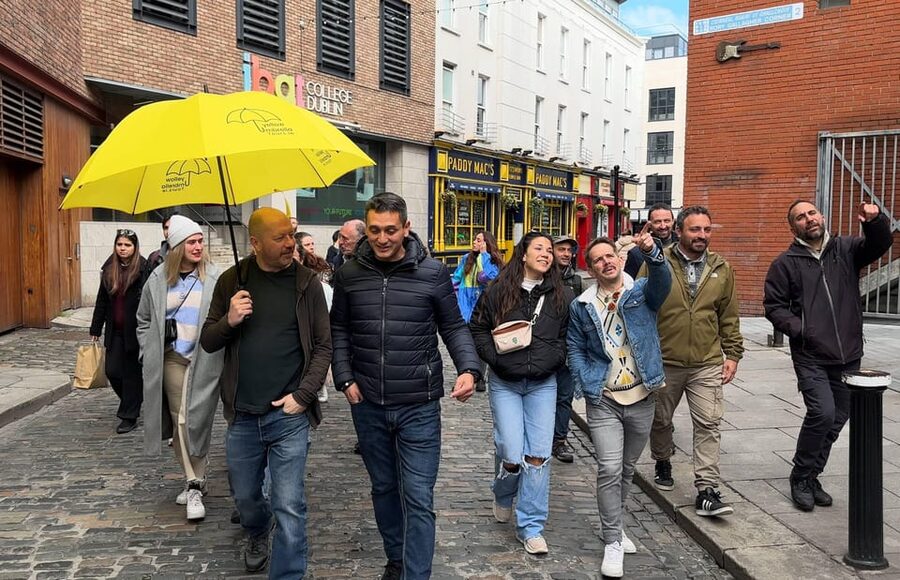
Temple Bar is Dublin’s most famous pub and live-music district, but the tour places it in an older setting. The area dates from the Tudor conquest in the 16th century, long before its current reputation for nightlife.
You will see the district as part of the old city, not just as a place to find a pint. That distinction is helpful. Temple Bar can feel heavily geared toward entertainment, and many people pass through without realizing how old the area is or how it fits into Dublin’s development.
The route includes pubs, live music, and the lively atmosphere for which Temple Bar is known. It does not include a pub stop or a drink, so you should treat this as a walking and orientation section. The guide can help you understand where you are, then you can decide if you want to return later for music or a meal.
This is also a good point to remember that Dublin is not a museum city sealed behind glass. Its history sits beside ordinary modern use. A street can be a Tudor-era district, a tourist meeting place, and a working nightlife zone all at once.
Crossing the Liffey and seeing Dublin from the north
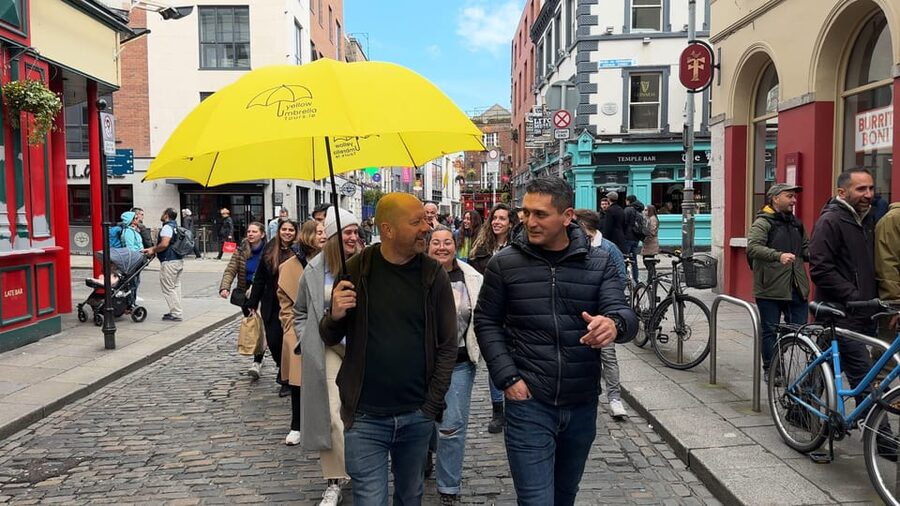
The tour crosses the River Liffey to Dublin’s north side for a broader view of the city. From the original Celtic settlement dating back about 2,100 years, the story reaches forward to the Silicon Docks and the influence of American technology companies in 21st-century Dublin.
That contrast is one of the route’s best features. You move from ancient settlement to Viking harbor, British government, Georgian finance, and modern tech development in a single city walk. The tour does not present Dublin as frozen in its old buildings. It shows a capital still changing.
The route then crosses back over the iconic Ha’Penny Bridge. The bridge leads toward Merchant’s Arch and Crown Alley, where the guide discusses Central Plaza, Sam Stephenson’s brutalist building.
You may not love the building itself, but that is part of the point. Dublin’s architectural story includes grand Georgian facades, medieval churches, modern technology offices, and controversial concrete structures. The stop gives you a chance to consider how newer buildings sit beside the old center.
The river crossings also help you get your bearings. Dublin’s historic sights can seem scattered when you first arrive. Walking across the Liffey makes the city’s north and south sides easier to understand.
College Green and Georgian Dublin

The route continues to College Green, one of the city’s most impressive architectural settings. Here, banks and former parliament buildings show off the fine neo-classical Georgian style associated with Dublin’s period as a major center of government and finance.
The guide describes this as a city that considered itself the second city of the British Empire. That idea helps explain the scale and confidence of the buildings. They were not designed for a minor provincial town. They reflected political ambition, money, and a desire to match the great capitals of the period.
For you, the practical value is visual context. Dublin’s grand civic buildings can be easy to admire without understanding why they were built that way. The tour gives you the political and financial background before leading you on to the next stops.
College Green is also a useful place to compare Dublin’s different architectural moods. Earlier, you saw cathedral stone and castle courtyards. Here, the style becomes formal and symmetrical. Soon after, the walk returns to more familiar street scenes and popular characters.
Molly Malone and the final walk to Trinity College
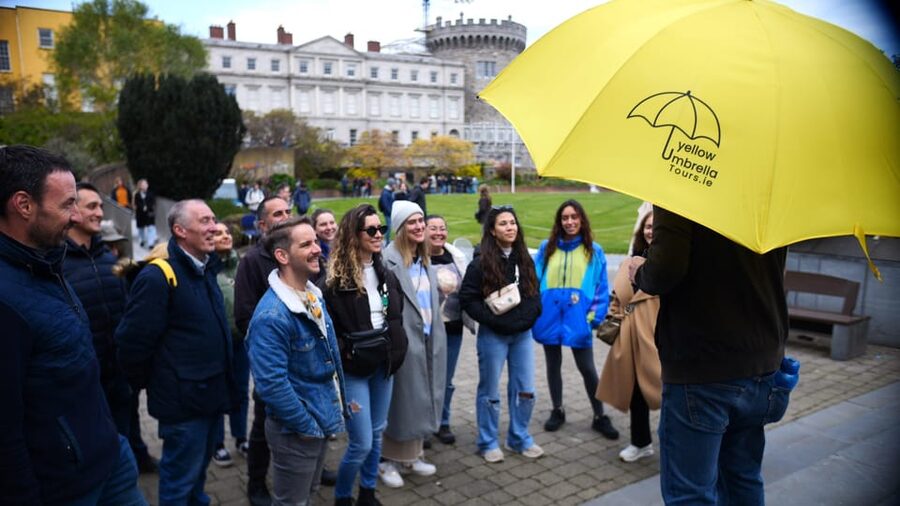
No quick introduction to Dublin would feel complete without Molly Malone. The tour pauses outside St. Andrew’s Church to say hello to Dublin’s favorite daughter before continuing toward Trinity College.
Molly Malone is a lighthearted stop after the heavier subjects of conquest, religion, government, and independence. It also gives the walk a distinctly Dublin character. You are not only visiting official monuments. You are meeting one of the city’s best-known public figures, even in statue form.
The final destination is the front gate of Trinity College, home to the famous Book of Kells exhibition. The tour ends here, then returns to the original meeting point according to the activity details. Since the walk finishes at the college gate, you should not assume that admission to the Book of Kells exhibition is part of the $19 price.
If the manuscript is a priority, use the tour to learn where Trinity is and how it fits into the center, then arrange a separate visit. Ending outside the college is still useful because you finish with one of Dublin’s most important cultural attractions directly in front of you.
What the $19 price really gives you
At $19 per person, this is a low-cost way to organize your first look at Dublin’s old center. The route covers cathedrals, a castle, a garden, a famous pub district, river crossings, Georgian buildings, Molly Malone, and Trinity College. Seeing all of those areas independently would take planning and repeated map checks.
The price does not include entry into the cathedrals, Dublin Castle, Chester Beatty Library, or the Book of Kells exhibition. That is not a flaw if you want a guided orientation. It matters if you expect a series of inside visits.
I see the best value in the connections between sites. Peter has been praised for answering extra questions, adjusting the tour to a guest’s level of English, and giving suggestions for the rest of a Dublin stay. Those personal touches can save you time after the walk, especially if this is your first day in the city.
The tour lasts two hours, so it also works well as a first activity before lunch or an afternoon of independent sightseeing. Check the available starting times when booking, since the precise schedule is not fixed in the information provided.
Who will enjoy this walk most
I would recommend this tour to a first-time Dublin visitor who wants the main sights placed in historical order. It suits you if you prefer walking, short explanations, and a broad overview rather than spending two hours inside one attraction.
It is also a good choice if you want to ask questions as you go. Peter’s approach, based on the feedback available, is friendly and flexible. If you are nervous about speaking English, the fact that he adjusts his explanations may make the experience more comfortable.
The tour may be less satisfying if you already know central Dublin well or want detailed architectural study. It also may not be enough for someone whose main goal is the Book of Kells, cathedral interiors, or Dublin Castle rooms. In those cases, use this walk as a map in human form, then return to the sites that deserve more time.
The activity is listed as wheelchair accessible and is conducted in English with a live guide. Free cancellation is available up to 24 hours before the tour for a full refund, and you can reserve now and pay later.
Should you book the Dublin Bucket List Sights Walk?
Book it if you want a reasonably priced introduction to central Dublin with a clear historical thread. The strongest reasons are the range of sights, the Viking-to-Silicon-Docks story, and the chance to get practical advice from a guide such as Peter.
Skip it if you want admission to the attractions or a slow, specialist tour of one landmark. For most first visits, though, two hours and $19 is a fair exchange for a guided route through Dublin’s oldest and most important center. Bring comfortable shoes, meet the yellow umbrella outside the Bull and Castle, and save time afterward for the interiors that interest you most.
FAQ
How much does the Dublin Bucket List Sights Walking Tour cost?
The tour costs $19 per person.
How long does the tour last?
The walking tour lasts two hours. Starting times depend on availability.
Where does the tour begin?
Meet the guide across the road from Christchurch Cathedral, outside the Bull and Castle.
How will I find the guide?
Look for the yellow umbrella at the meeting point.
Where does the tour end?
The activity ends back at the original meeting point. The route itself finishes outside the front gate of Trinity College.
What language is the tour conducted in?
The live guided tour is conducted in English.
Is the tour wheelchair accessible?
Yes, the activity is listed as wheelchair accessible.
Are admission tickets to the attractions included?
The included service is a guided tour of Dublin’s main sights. Admission tickets for the cathedrals, Dublin Castle, Chester Beatty Library, and the Book of Kells exhibition are not specified as included.
Can I cancel the tour for a refund?
Yes. You can cancel up to 24 hours in advance for a full refund. You can also reserve your place and pay later.
Just added around Dublin
- A Self Guided Walking Tour of Dublin’s Docklands★ 4.5 · 3 reviews
- Waterford Crystal and Kilkenny Full-Day Rail Tour from Dublin★ 5.0 · 3 reviews
- Secret and unusual Dublin: guided walking tour★ 5.0 · 3 reviews
- Turtle Bunbury’s Dublin: A Self-Guided Audio Tour from a Celebrated Author★ 5.0 · 3 reviews
- Cliffs of Moher and The Burren Private Tour from Dublin★ 5.0 · 3 reviews
- Skip-the-line St. Patrick’s Cathedral and Dublin City Tour★ 5.0 · 3 reviews
- Dublin Full-Day Tour through Boyne Valley★ 5.0 · 3 reviews
- Rock Of Cashel And Blarney Castle Private Chauffeur Full Day Sightseeing Tour★ 4.5 · 3 reviews
Walking Tours, compared.

Dublin Highlights and Hidden Gems Guided Walking Tour
Read our review →

90 Minute Dublin Walking tour and Sightseeing tips
Read our review →

Historical 2-Hour Guided Walking Tour of Dublin
Read our review →
Dublin Traditional Irish 3 Course Meal Walking Tour with Local
Read our review →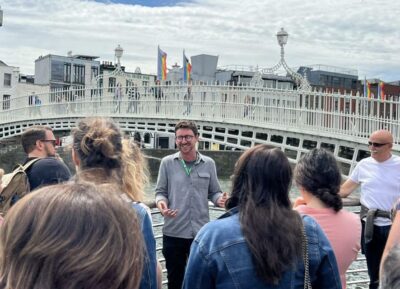
Browse the lists this tour appears in