
Reviewed · WALKING TOURS
Dublin: Hidden Gem Walking Tour with Local Guide
Tallaght has more stories than most visitors expect. This two-hour walk moves through Kingswood, Belgard, TU Dublin, St Maelruain’s, and Tallaght Village, showing how a rural settlement became one of Ireland’s largest urban areas. I like the mix of people and places: Katharine Tynan, war correspondent William Howard Russell, poet Alice Furlong, Irish mythology, old factories, and the former Tallaght Aerodrome all share the route.
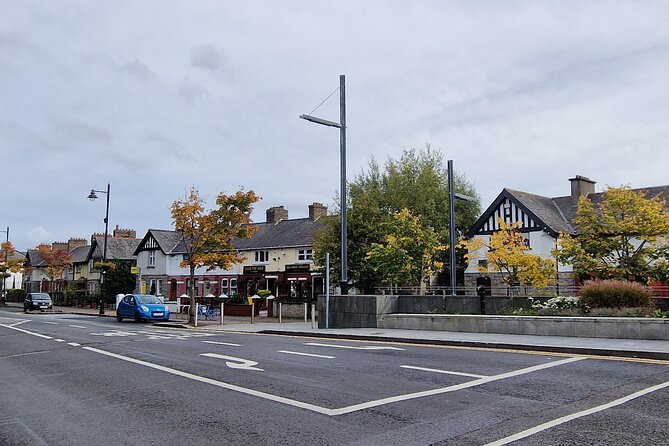
I also like the personal touch from local guide Sophie, who brings letters, poems, photographs, and Irish-language material into the walk. The main consideration is that this is not a classic central Dublin stroll through grand Georgian streets. Some sections pass through modern suburban areas and retail surroundings, so you should book it for local stories and context rather than postcard scenery. The Dublin Mountains view and Tallaght Village provide welcome visual highlights.
In This Review
- Key points to know before you go
- Why Tallaght makes a worthwhile walking tour
- Kingswood and the beginnings of Tallaght
- Katharine Tynan’s Whitehall connection
- William Howard Russell, Tallaght’s pioneering reporter
- Oisín, Tír na nÓg, and the Dublin Mountains
- Tallaght Aerodrome, Urney Chocolates, and Jacob’s
- Tallaght’s rapid change in the 1970s and 1980s
- St Maelruain’s and the medieval foundations
- Alice Furlong and the Irish language
- The Fenian Rising in Tallaght Village
- Cottages, the old tramway, and a few Irish phrases
- Price, group size, and practical value
- Who should book the Tallaght walk?
- Should you book it?
- FAQ
- Where does the tour begin?
- Where does the tour end?
- How long does the walking tour last?
- How much does the tour cost?
- What language is the tour offered in?
- How many people can join the tour?
- Is the tour suitable for most people?
- What happens if the weather is poor?
- Can I cancel for a full refund?
Key points to know before you go
- Tallaght beyond the usual Dublin route: Explore a part of County Dublin that many sightseeing itineraries skip.
- Literary connections: Learn about Katharine Tynan’s friendships with W.B. Yeats and George William Russell, also known as AE.
- War reporting and Irish history: Follow William Howard Russell from Tallaght to the Crimean War, the American Civil War, and the Great Famine.
- A bilingual Irish legend: Hear Oisín in the Land of Youth in Irish and English, with a view toward the Dublin Mountains.
- Small and affordable: The tour costs $18.05 per person, lasts about two hours, and accepts no more than 12 people.
- A local finish: End beside a bilingual Irish and English café in Tallaght Village, where you can try out a few Irish phrases.
Why Tallaght makes a worthwhile walking tour
Tallaght is often treated as a modern outer suburb of Dublin. That description misses much of the story. The area reaches back to early Irish monastic life, carries links to writers and political movements, and changed dramatically during the 1970s and 1980s.
This tour is useful because it joins those periods together. You are not simply hearing a list of dates. You are shown how old rural Tallaght, industrial Tallaght, and modern urban Tallaght fit into one place.
The route also gives attention to people who are easy to overlook. Katharine Tynan wrote extensively and moved within Irish and English literary circles. William Howard Russell helped define the work of the modern war correspondent. Alice Furlong wrote in Irish and English and supported the Irish language and the independence movement.
That combination gives the walk a clear purpose. You see Tallaght through literature, journalism, mythology, business, transport, religion, and urban change.
More Walking Tours in Dublin
- Dublin Highlights and Hidden Gems Guided Walking Tour
★ 5.0 · 6,020 reviews - Dublin: Highlights and Hidden Gems Walking Tour
★ 4.9 · 2,140 reviews - 1916 Rebellion Walking Tour
★ 5.0 · 1,605 reviews
Kingswood and the beginnings of Tallaght
The walk begins at Kingswood Heights, where Sophie briefly introduces you to Tallaght and its early place in Irish history. This opening lasts only about five minutes, so it functions as a quick orientation rather than a full lesson in ancient Ireland.
That is a sensible start. You get the broad setting before moving into the more detailed stories. Tallaght’s early importance is tied to religious foundations and the wider development of the area, themes that return later at St Maelruain’s.
The meeting point is in Kingswood, in the Kilnamanagh area of Dublin. You should allow time to find the exact starting point and arrive ready to walk. The walk ends in Tallaght Village, so the start and finish are in different parts of Tallaght.
Katharine Tynan’s Whitehall connection
The next stop is outside Whitehall, the former home of Katharine Tynan. This is one of the more unusual literary stops in Dublin because it links a residential setting with major figures of the Irish literary world.
Sophie discusses Tynan’s life and writing, along with her place in both Irish and English literary circles. Her friendships with W.B. Yeats and George William Russell, known as AE, add extra interest. Letters from Tynan to Yeats and AE are shared, giving the story a more personal feel than a standard biography.
I especially like the use of correspondence here. A letter can show tone, friendship, and daily concerns in a way that a plaque cannot. You also get a sense of how writers and thinkers connected beyond the famous names most visitors already know.
The stop lasts about 15 minutes. Since the group remains outside the former residence, you should not expect an interior house visit. The value is in the setting and the interpretation.
William Howard Russell, Tallaght’s pioneering reporter
At Belgard Road, the tour turns to William Howard Russell, who was born in Jobstown, Tallaght. Russell became one of the first major war correspondents and spent much of his career reporting for The Times.
His work took him from reports on Daniel O’Connell’s meetings and the Great Famine in Ireland to the Crimean War and the American Civil War. The tour also touches on his friendship with Charles Dickens.
This stop gives Tallaght an unexpectedly wide reach. A local birthplace connects with some of the most important political and military events of the nineteenth century. Russell’s writings and letters help show how reporting was changing, and how accounts from distant conflicts reached readers at home.
You spend about 10 minutes here. That is enough for a focused introduction, but not enough for a full study of Russell’s career. I would treat it as a strong story within a larger walk, not as a specialist journalism tour.
A completely different kind of day out from Dublin:
- Dublin to Cliffs of Moher, including Wild Atlantic Way and Galway
★ 5.0 · 23,331 reviews - From Dublin: Cliffs of Moher, Burren & Galway City Day Tour
★ 4.8 · 18,888 reviews - Dublin: Guinness Storehouse Entry Ticket
★ 4.6 · 16,863 reviews - Dublin to Cliffs of Moher, Burren, Wild Atlantic Way, Galway Tour
★ 5.0 · 12,924 reviews
Oisín, Tír na nÓg, and the Dublin Mountains
The next Belgard Road stop shifts from documented history to Irish mythology. Sophie introduces the background of Irish myths before telling Oisín in the Land of Youth in both Irish and English.
This bilingual presentation is a particularly good fit for the tour. You hear the familiar English version while also encountering the Irish language in a meaningful setting. The story’s link to the Dublin Mountains gives the view more purpose. Instead of being scenery between stops, the mountains become part of the legend.
The stop lasts around 10 minutes. The mountain view is one of the more scenic moments on a route that also includes modern roads and commercial areas. Weather will affect how much you enjoy this section, which is one reason the tour requires good conditions.
Tallaght Aerodrome, Urney Chocolates, and Jacob’s
At Belgard Retail Park, the subject changes again. This area once held Tallaght Aerodrome, built on land belonging to Katharine Tynan’s father.
The aerodrome played a role during the First World War, the Irish War of Independence, and the Irish Civil War. Katharine Tynan’s connection returns here, with a poem about the development shared during the stop. It is a good example of how the tour keeps linking people and places rather than treating each subject as an isolated fact.
The stop also covers the Gallagher family and the creation of Urney Chocolates. The company became a familiar Irish brand and operated in Tallaght for decades before closing in 1980. You will also hear how the Urney name continues to live on.
Jacob’s receives a shorter mention. Its operations in Tallaght, along with Urney’s presence, helped change the area through employment and industry. This section is valuable because it explains urban growth through ordinary working life, not only through famous people or political events.
The stop lasts about 15 minutes. The modern retail setting may not feel historic, but that contrast is part of the point. You are being asked to picture an aerodrome and factories where today you see commercial development.
Tallaght’s rapid change in the 1970s and 1980s
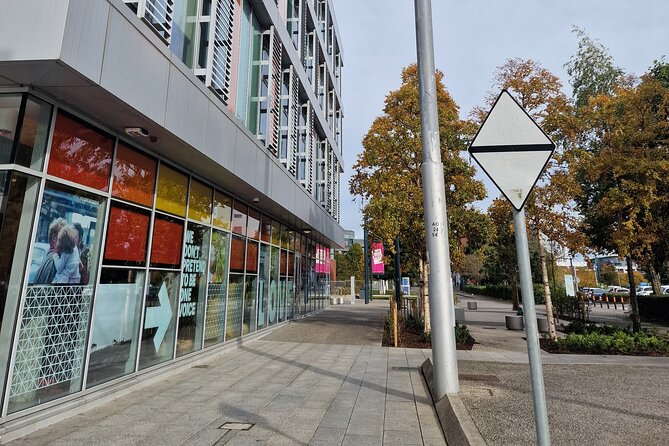
At TU Dublin’s Tallaght Campus, the tour spends about 15 minutes examining the area’s major transformation. During the 1970s and 1980s, Tallaght grew into one of Ireland’s largest urban areas and was one of the fastest-growing urban centres in Western Europe in the 1980s.
Sophie places this change against the wider problems facing Ireland at the time, including economic hardship, unemployment, and emigration. That context matters. New housing and population growth did not happen in a vacuum. They affected families, services, identity, and the way people understood the area.
This is likely to be one of the most useful stops for anyone who knows modern Dublin but has never thought much about how Tallaght developed. Old photographs and other visual material help you compare earlier Tallaght with the place you are walking through now.
The tour does not present urban growth as a simple success story. It looks at what rapid expansion meant for local people. That balance gives the modern section more weight than a quick comment about suburban development.
St Maelruain’s and the medieval foundations
The route then reaches St Maelruain’s Church of Ireland. The present church occupies the site of a former monastery, an important religious centre in ancient Ireland.
Sophie explains the role of St Maelruain and the monastery’s place alongside the foundation at Finglas. Together, these sites were known as the two eyes of Ireland, a phrase that signals their importance in the religious life of the period.
This five-minute stop is brief, but it changes the scale of the walk. After hearing about modern housing, factories, and urban growth, you are reminded that Tallaght’s story begins many centuries earlier.
The church grounds also contain the grave of Alice Furlong, whose story receives a longer treatment. That makes St Maelruain’s more than a quick architectural stop. It becomes a meeting point for early religious history and modern Irish cultural history.
Alice Furlong and the Irish language
Alice Furlong was one of the founding members and a vice-president of Inghinidhe na hÉireann, or Daughters of Ireland. She was also a poet, writer, and advocate for the Irish language.
Her connection with Tallaght is central to this part of the walk. Sophie discusses Furlong’s life and shares examples of her poetry in Irish and English, with professional English translations provided for the Irish-language work.
I like this approach because it avoids treating Irish as a decorative extra. You hear how language, place, and identity connected for Furlong. The bilingual material also makes the subject accessible if you do not speak Irish.
The stop lasts about 15 minutes. If you have an interest in poetry, women’s history, Irish nationalism, or the revival of the Irish language, this may be one of the strongest parts of the tour.
The Fenian Rising in Tallaght Village
In Tallaght Village, a plaque marks the Fenian Rising of 1867. The tour uses this site to explain the rising and Tallaght’s role in that period of Irish history.
Charles Dickens’ writings about the period are also brought into the discussion. That outside perspective adds texture to the local account, showing how events in Tallaght could be viewed and recorded by a major English writer.
The stop takes about 10 minutes. It is another example of the tour’s method: begin with something visible, then use it to explain a much wider story.
You should not expect a large museum display or preserved battlefield. The experience depends on Sophie’s storytelling and the material she shares. For that reason, the small group size matters. With a maximum of 12 people, it should be easier to hear the detail and ask questions.
Cottages, the old tramway, and a few Irish phrases
The final section takes place in Tallaght Village, where you see cottages designed by architect Thomas Joseph Byrne. Sophie also discusses the former Dublin and Blessington Steam Tramway, which ran through the area before closing in 1932.
The tramway helps explain how Tallaght connected with Dublin in an earlier period. Its presence also adds another layer to the story of transport and growth, alongside the later roads and urban expansion seen elsewhere on the route.
The tour ends with a short introduction to basic Irish. You can use the phrases at a bilingual Irish and English café beside the end point in the centre of Tallaght Village.
That is a pleasant way to finish. You leave with more than a set of historical facts and a few photographs. You have also learned a little language and have the option of continuing the local theme at the café.
Price, group size, and practical value
At $18.05 per person, this is an inexpensive two-hour activity. The value is strongest if you want a local perspective and enjoy stories about people, language, and change. The guide supplies the interpretation, while the area itself provides the evidence.
The tour is limited to 12 people and includes a local guide. A small group is helpful here because many stops depend on conversation, shared texts, and questions rather than large monuments.
The walk is offered in English and uses a mobile ticket. It begins at Kingswood, Kilnamanagh, Dublin, and ends at Tallaght Village, beside the bilingual café. The tour is near public transportation, and most people can take part. Service animals are allowed.
You should plan for outdoor conditions. The experience requires good weather, and poor weather can lead to a new date or a full refund. Free cancellation is available up to 24 hours before the start time. If you cancel later, the payment is not refunded, and changes made inside that 24-hour period are not accepted.
Who should book the Tallaght walk?
I would choose this tour if you have already seen central Dublin and want a different side of the city. It is also a strong choice for Dublin residents who know Tallaght as a modern suburb but have never explored its older stories.
History fans will find plenty to follow, especially in the sections on Russell, the Fenian Rising, St Maelruain’s, and the aerodrome. Readers interested in Irish literature should pay close attention to Tynan and Furlong. The Irish-language elements make the experience appealing to anyone who wants more than a standard sightseeing route.
I would be more cautious if you want grand buildings, museum interiors, or a tightly packed list of famous Dublin landmarks. Several stops are in modern surroundings, and the appeal depends on Sophie’s explanations. The mountain view adds scenery, but this is primarily a local history walk.
Should you book it?
Book it if you want an affordable, small-group introduction to Tallaght’s past and present. The strongest reasons are the range of subjects, the use of letters, poems, photographs, and bilingual material, and Sophie’s clear connection to the area.
Skip it if your time in Dublin is very short and you want only the city centre. But if you can spare two hours, this walk offers a thoughtful look at a part of Dublin that is often passed by. You may leave seeing Tallaght not as an outer suburb, but as a place shaped by monasteries, writers, reporters, factories, political movements, and rapid modern growth.
FAQ
Where does the tour begin?
The tour begins in Kingswood Heights, in the Kilnamanagh area of Dublin, County Dublin.
Where does the tour end?
It ends in Tallaght Village on R819, beside a bilingual Irish and English café.
How long does the walking tour last?
The tour lasts approximately two hours.
How much does the tour cost?
The listed price is $18.05 per person.
What language is the tour offered in?
The tour is offered in English. Irish-language material is also included, with English translations provided for the Irish poetry and a bilingual version of the Oisín legend.
How many people can join the tour?
The maximum group size is 12 people.
Is the tour suitable for most people?
Most people can participate, and the tour is near public transportation. Service animals are allowed.
What happens if the weather is poor?
Because the experience requires good weather, a cancellation caused by poor conditions results in an offer of a different date or a full refund.
Can I cancel for a full refund?
Yes. You can cancel at least 24 hours before the start time for a full refund. Cancellations and changes made less than 24 hours before the start time are not accepted for a refund.
Just added around Dublin
- A Self Guided Walking Tour of Dublin’s Docklands★ 4.5 · 3 reviews
- Waterford Crystal and Kilkenny Full-Day Rail Tour from Dublin★ 5.0 · 3 reviews
- Turtle Bunbury’s Dublin: A Self-Guided Audio Tour from a Celebrated Author★ 5.0 · 3 reviews
- Secret and unusual Dublin: guided walking tour★ 5.0 · 3 reviews
- Cliffs of Moher and The Burren Private Tour from Dublin★ 5.0 · 3 reviews
- Skip-the-line St. Patrick’s Cathedral and Dublin City Tour★ 5.0 · 3 reviews
- Dublin Full-Day Tour through Boyne Valley★ 5.0 · 3 reviews
- Rock Of Cashel And Blarney Castle Private Chauffeur Full Day Sightseeing Tour★ 4.5 · 3 reviews
Walking Tours, compared.
Dublin Highlights and Hidden Gems Guided Walking Tour
Read our review →

90 Minute Dublin Walking tour and Sightseeing tips
Read our review →

Historical 2-Hour Guided Walking Tour of Dublin
Read our review →
Dublin Traditional Irish 3 Course Meal Walking Tour with Local
Read our review →
Browse the lists this tour appears in