

Reviewed · HISTORICAL TOURS
Dublin: Macabre History Walking Tour
Death has shaped Dublin, too. This two-hour walk follows old streets, both sides of the River Liffey, and overlooked corners where the city’s darker stories took place. I especially like the mix of documented history and grisly folklore, plus the lively storytelling from guides such as Peter and Rob. The main drawback is that one recent assessment found the tour less bloody than expected, so this is more historical than horror-show theatrical.
I also like the small-group feel reported by several people, including groups of only three who enjoyed what felt like a private outing. At $19 per person, the tour offers a good-value way to see parts of central Dublin you might otherwise pass without a second glance. You should be comfortable with two hours on foot, and the subject matter is not suitable for children under 18.
In This Review
- Key points to know before you book
- A different way to read Dublin’s old center
- Finding the yellow umbrella at the Spire
- Cuchulainn and the city’s oldest violent stories
- Medieval quarantines and life beside the city walls
- Grave robbing beside the city mortuary
- The legless serial killer and Dublin’s criminal past
- Public executions and Dublin’s harsh punishments
- Man-eating rats, mummified corpses, and the final cathedral story
- What the guides do especially well
- Is $19 a fair price for two hours?
- Who should choose this Dublin walk?
- Should you book the Macabre History Walking Tour?
- FAQ
- Where does the tour start?
- Where does the tour finish?
- How long does the tour last?
- What language is the tour in?
- Is the tour suitable for children?
- Is the walking tour wheelchair accessible?
Key points to know before you book
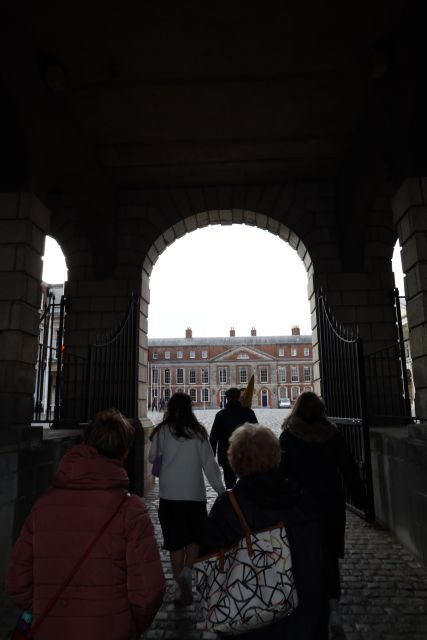
- Meet beside the Spire: Find the yellow umbrella on O’Connell Street, beside Dublin’s big needle.
- Cuchulainn begins the darker story: The tour brings the legendary warrior’s death into the city’s wider history of violence and myth.
- Expect grim details, not a haunted-house act: Grave robbing, public executions, quarantines, mummified bodies, and notorious criminals shape the walk.
- The route crosses both sides of the river: You get a broader look at old central Dublin rather than staying on one short street.
- Peter and Rob are praised for storytelling: Their humor, clear explanations, acting, and willingness to answer questions are a major part of the experience.
- Plan for adults only: The tour is in English, lasts two hours, returns to the meeting point, and is wheelchair accessible.
A different way to read Dublin’s old center

Many Dublin sightseeing walks focus on famous writers, pubs, churches, and political events. This one looks at what people tried to hide, fear, or profit from: sickness, death, punishment, crime, and the grim business surrounding human remains.
That theme gives you a useful reason to examine ordinary streets more closely. A lane, wall, or cathedral corner may not look dramatic at first. Then your guide adds the story of what happened there, or what once stood nearby, and the modern city takes on another layer.
I like this approach because it does not require a museum ticket or a long coach ride. You move through the old city center while the guide connects places to stories. The walk also crosses both sides of the River Liffey, giving the route a sense of movement instead of keeping you in one compact cluster.
The tone appears to be more playful and story-led than solemn. Peter is praised for mixing humor with historical detail, while Rob is described as personable, entertaining, and good at bringing stories to life. That matters here. Macabre subjects can become tiresome if delivered as a list of dates and names, but a strong narrator gives each tale shape and character.
More Historical Tours in Dublin
- Dublin Historical Centre Food Tour with 8 Food Tastings & Drinks
★ 5.0 · 1,718 reviews - 2-Hour Historical Walking Tour from Dublin
★ 5.0 · 875 reviews - Historical 2-Hour Guided Walking Tour of Dublin
★ 4.7 · 865 reviews
Finding the yellow umbrella at the Spire
The meeting point is beside the Spire, the tall needle in the middle of O’Connell Street. Look for the yellow umbrella. This is a sensible place to begin because the landmark is hard to miss, though one useful warning is that there may be more than one yellow umbrella in the area.
Arrive with enough time to identify the correct guide rather than rushing up at the start time. The tour does not include hotel pickup or drop-off, so you need to make your own way to O’Connell Street. The walk ends back at the same meeting point, which makes it easier to continue sightseeing or arrange transport afterward.
Starting on O’Connell Street also creates a contrast between modern Dublin traffic and the older stories ahead. You begin in a familiar city setting, then move toward lesser-known parts of the center. That change is part of the appeal: the tour does not need a ruined castle or remote graveyard to find unsettling material.
Cuchulainn and the city’s oldest violent stories
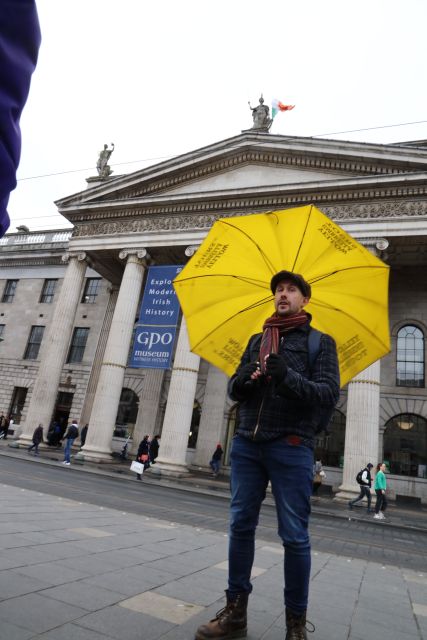
One of the first featured subjects is the Death of Cuchulainn, the mighty warrior from Irish legend. The tale includes the raven on his shoulder and the grim detail of his eyes being pecked out.
This stop sets the mood well because it shows that Dublin’s macabre stories are not limited to recent murders or Victorian crime. Irish mythology carries its own violence, tragedy, and strange imagery. You get a sense of how old stories can sit beside later city history, even when the two belong to very different worlds.
I would not book this tour expecting a carefully separated lecture on mythology, medieval Dublin, and modern crime. The pleasure comes from the succession of stories and the changing eras. The guide moves between legend and historical events, giving you curious details that ordinary city tours often leave out.
That mixture also explains why the experience may suit someone who wants more than ghost stories. You hear about death and fear, but the route also gives you a less familiar way to understand Dublin’s past. Peter is especially praised for making complicated material easy to follow and for slowing down or explaining a point when someone needs it.
Medieval quarantines and life beside the city walls
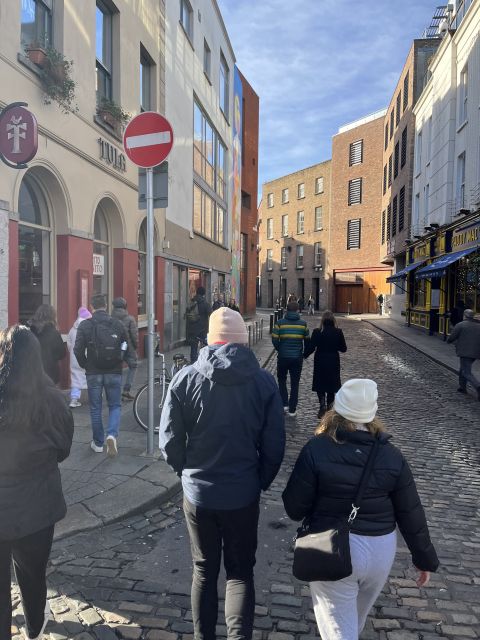
Near the old city walls, the tour turns toward stories of medieval disease and quarantine. These subjects can be uncomfortable, but they explain how earlier Dublin dealt with sickness before modern medicine and public health systems.
The old walls are valuable here not simply as surviving pieces of architecture, but as clues to how the city was organized. A wall suggests boundaries, control, and crowded living conditions. When your guide adds stories of quarantine, the setting becomes a reminder that disease could shape where people went, whom they saw, and how communities responded to danger.
The route also includes accounts of mummified corpses. The supplied details do not promise a visit inside a crypt or a formal display, so you should think of this as a storytelling stop rather than a museum experience. Still, the subject fits the walk’s main strength: ordinary places become prompts for unusual pieces of Dublin’s past.
This part may appeal most to you if you enjoy social history. The tour is not only about villains. It also touches on how people lived with death as a regular part of city life, and how fear changed daily behavior.
More Walking Tours in Dublin
- Dublin Highlights and Hidden Gems Guided Walking Tour
★ 5.0 · 6,020 reviews - Dublin: Highlights and Hidden Gems Walking Tour
★ 4.9 · 2,140 reviews - 1916 Rebellion Walking Tour
★ 5.0 · 1,605 reviews - 90 Minute Dublin Walking tour and Sightseeing tips
★ 5.0 · 916 reviews
Grave robbing beside the city mortuary

One of the most memorable subjects is the thriving nineteenth-century business of grave robbing beside the city mortuary. It is a particularly effective story because it connects death with money, demand, and a city’s medical and institutional life.
The phrase thriving business is important. The story is not just about one shocking act. It points to a larger trade and to the uncomfortable ways bodies could become valuable after death. Your guide can use that subject to show how Dublin’s past included people who made a living from practices that modern visitors find appalling.
This is also where the tour’s balance between fact and entertainment matters. Some details are presented as historical information, while others may be told as colorful local tales. One person rated the experience highly but wished it had been darker and bloodier. That is a fair warning: the walk uses macabre material, but it is not necessarily a nonstop sequence of graphic scenes.
I see that as a benefit for many adults. You get disturbing ideas and strong stories without committing to a theatrical scare attraction. If you want horror makeup, jump scares, or actors hiding in alleys, this is probably the wrong choice. If you prefer history with an uneasy edge, the subject should work well.
The legless serial killer and Dublin’s criminal past
Close to the old city walls, the guide tells the story of a legless serial killer. The available details do not identify the person, so you should expect the guide to provide the full story during the walk rather than arrive with a complete name-and-date study.
This stop shows how the tour uses the city as a stage. A criminal story becomes more memorable when you are standing in the area connected with it, even if the modern surroundings look completely ordinary. That contrast is a recurring feature of the experience.
Peter is repeatedly praised for acting out parts of the stories and using humor without losing the thread of the history. Rob receives similar praise for a friendly manner and well-paced narration. Their performance style seems to be a major reason the walk works for solo participants as well as couples and small groups.
You can also ask questions along the way. That is useful because Dublin’s past includes names, customs, and references that may not be familiar to you. The guide’s willingness to answer questions turns the walk into more than a fixed speech, particularly when the group is small.
Public executions and Dublin’s harsh punishments
Public executions form another major theme. The subject is grim, but it reveals how punishment once operated as public spectacle. Execution was not hidden behind prison walls in the modern sense. It could draw a crowd and become part of the city’s public life.
The value of this section lies in the context. You are not only hearing who died and how. You are learning how authorities used fear, shame, and visibility to enforce order. That gives the macabre material a purpose beyond shock.
The route’s old streets and riverside sections suit this topic because they let you picture a city where movement, trade, punishment, and rumor happened close together. The tour does not claim to recreate the past physically, so keep your expectations realistic. You will be walking through present-day Dublin while listening to stories tied to earlier periods.
The guide’s humor can make these subjects easier to handle, but it may not suit everyone. If you prefer quiet memorial tours or a strictly academic tone, the performance element could feel too light. If you enjoy a narrator who keeps the pace moving, it is likely to be a plus.
Man-eating rats, mummified corpses, and the final cathedral story
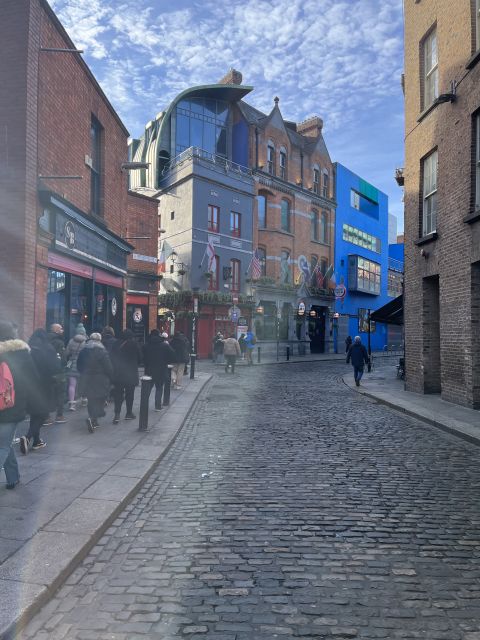
Man-eating rats provide one of the tour’s most startling headline subjects. The detail is memorable because it sounds almost too wild for a city history walk. It also reinforces the tour’s habit of moving between documented urban hardship and stories that have gathered a life of their own.
Again, the guide’s telling matters as much as the subject. A good storyteller can signal when a detail is certain, uncertain, legendary, or simply fun to repeat. One person described the material as a blend of probably fact and definitely entertaining information. That is a useful way to set your expectations.
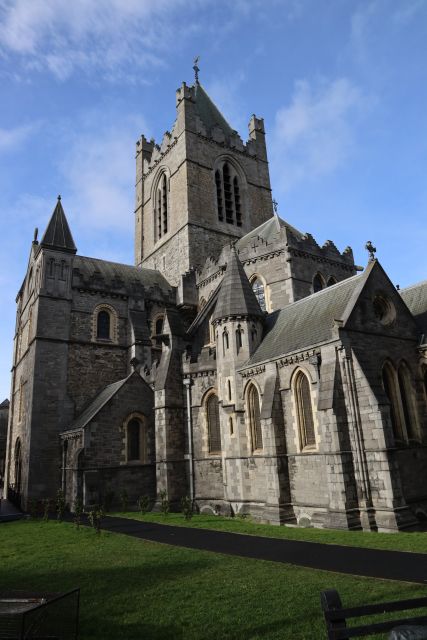
The walk finishes beside the cathedral with the story of Dublin’s most famous brothel keeper and her death by fire at the stake. This gives the tour a strong final chapter: crime, reputation, punishment, and an especially grim end.
The cathedral setting adds weight without requiring a special entry. You hear the story in the area connected with the final part of the route, then return to the starting point. Since the finish is not at the cathedral, you should not assume the walk includes an interior visit or a guided cathedral tour.
What the guides do especially well
The most consistent strength is the guide. Peter is praised for passion, clear explanations, warmth, and dramatic storytelling. Several people describe him as approachable and happy to answer questions, while others note that he makes sure everyone can follow the story.
That last point matters if English is not your first language. The tour is offered in English only, but Peter is described as adjusting his pace and explaining points when needed. Visitors from Germany, Italy, the Netherlands, and elsewhere found the presentation easy to follow.
Rob receives similar praise for his humor, personal style, and ability to keep the group engaged. One person compared his manner to comedian Max Fosh, which suggests a relaxed and contemporary presentation rather than a formal lecture.
Group size can vary. Some outings have been very small, even only three people, creating a private-tour feel. You should not treat that as guaranteed, but it is encouraging if you prefer conversation over standing in a large crowd. The meeting point is easy to find, though check carefully for the correct yellow umbrella.
Is $19 a fair price for two hours?
At $19 per person, this is a reasonable buy for a two-hour guided walk in central Dublin. You are paying for a live English-speaking guide, local stories, route planning, and access to details you might not notice alone. There is no hotel transport, food, or admission to a separate attraction, so the price is best judged as payment for interpretation rather than included extras.
I think the value is strongest if you have already seen Dublin’s main sights and want a different angle. The tour adds material that standard city walks may skip, especially grave robbing, public punishment, obscure criminals, and local macabre tales.
It is also a good first-day activity if you want to get your bearings on foot, though the route is designed around stories rather than major landmarks. The return to O’Connell Street makes it easy to pair with another central Dublin plan.
Free cancellation up to 24 hours before the start gives you useful flexibility, and you can reserve now and pay later. The tour is wheelchair accessible, though the supplied details do not describe every surface or street condition, so you may still want to confirm specific needs before booking.
Who should choose this Dublin walk?
I would choose it if you enjoy:
- Local history told through odd, unsettling details
- Walking rather than sitting on a bus
- Small groups and opportunities to ask questions
- Irish legend mixed with medieval and nineteenth-century history
- Guides who use humor, drama, and acting
- Places you might otherwise walk past
I would skip it if you want a purely factual academic lecture, a dedicated ghost hunt, or very graphic horror. The macabre theme is real, but the tone is accessible and sometimes playful.
It is not suitable for children under 18. Adults who enjoy dark history, solo visitors looking for a social activity, and repeat Dublin visitors seeking less familiar stories are the clearest match.
Should you book the Macabre History Walking Tour?
Yes, if you want a lively two-hour walk that shows Dublin from an unusual angle. The strongest reason to book is not one single tale, although the grave robbing, legless serial killer, and brothel keeper’s execution are memorable. It is the combination of lesser-seen streets and guides such as Peter and Rob, who turn grim material into an engaging city walk.
Book with the right expectation: this is macabre history with humor, not a full-scale horror performance. At $19, the tour offers solid value, especially when the group is small and the guide can respond to your questions. Meet beside the Spire, find the yellow umbrella, wear comfortable walking shoes, and give yourself two hours to see Dublin’s old center in a darker light.
FAQ
Where does the tour start?
It starts beside the Spire, the big needle in the middle of O’Connell Street. Look for the yellow umbrella.
Where does the tour finish?
The walk ends back at the meeting point beside the Spire.
How long does the tour last?
The tour lasts two hours. Starting times vary, so check availability when booking.
What language is the tour in?
The live guided tour is conducted in English.
Is the tour suitable for children?
No. The activity is not suitable for children under 18.
Is the walking tour wheelchair accessible?
Yes, the activity is listed as wheelchair accessible.
Just added around Dublin
- A Self Guided Walking Tour of Dublin’s Docklands★ 4.5 · 3 reviews
- Waterford Crystal and Kilkenny Full-Day Rail Tour from Dublin★ 5.0 · 3 reviews
- Secret and unusual Dublin: guided walking tour★ 5.0 · 3 reviews
- Turtle Bunbury’s Dublin: A Self-Guided Audio Tour from a Celebrated Author★ 5.0 · 3 reviews
- Cliffs of Moher and The Burren Private Tour from Dublin★ 5.0 · 3 reviews
- Skip-the-line St. Patrick’s Cathedral and Dublin City Tour★ 5.0 · 3 reviews
- Dublin Full-Day Tour through Boyne Valley★ 5.0 · 3 reviews
- Rock Of Cashel And Blarney Castle Private Chauffeur Full Day Sightseeing Tour★ 4.5 · 3 reviews
Historical Tours, compared.

Dublin Historical Centre Food Tour with 8 Food Tastings & Drinks
Read our review →

Historical 2-Hour Guided Walking Tour of Dublin
Read our review →
Dublin to Cork, Blarney Castle & Cóbh Heritage Centre by train
Read our review →
Jeanie Johnston Tall Ship Irish Famine History Tour
Read our review →

Deliciously Dublin: The Artisan Donut Walking & History Tour
Read our review →Browse the lists this tour appears in