
Reviewed · WALKING TOURS
Private Walking Tour in Dublin
Dublin’s story fits neatly into a good walk. This private 2 to 3 hour tour links Trinity College, the Easter Rising site, Viking Dublin, medieval churches, Dublin Castle, and the city’s best-known streets. I like the personal format, since your guide can adjust the conversation for your group, and I like the route itself, which gives you a useful first look at central Dublin rather than parking you in one district. The main consideration is cost: at $90.11 per person, it is a serious outlay, and admission fees for several major sights are not included.
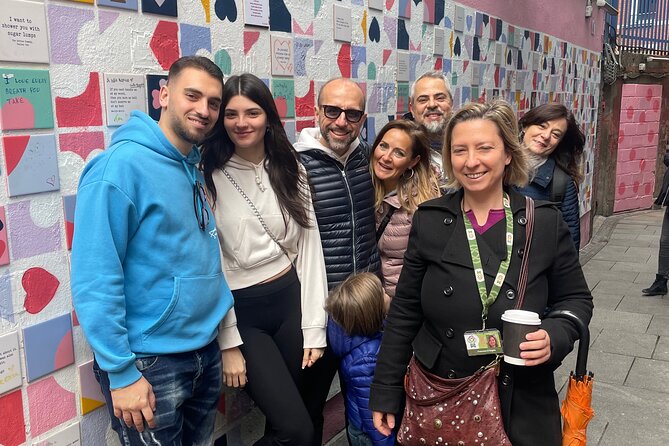
I also like the clear finish at the Molly Malone statue, close to many central shops and cafés. Guides such as Sinead, John, Francesca, and Yvonne have been praised for friendly explanations, strong local knowledge, and adapting the walk for families and different interests. You should be ready for outdoor walking in changeable weather, and remember that a short stop at a cathedral or castle is not the same as a full interior visit.
In This Review
- Key points at a glance
- Why this private Dublin walk works as a first look
- Trinity College and the literary side of Dublin
- The GPO and the Easter Rising
- The Spire, Ha’penny Bridge, and Temple Bar
- Viking Dublin at Wood Quay
- Christ Church and Saint Patrick’s Cathedral
- Dublin Castle and the story of British rule
- George’s Street Arcade and Molly Malone
- What the guides add to the experience
- Price, tickets, pace, and practical value
- Who should book this Dublin walking tour?
- Should you book it?
- FAQ
- How long does the private walking tour last?
- Where does the tour begin?
- Where does the tour finish?
- Is this a private tour?
- What language is the tour offered in?
- Are admission fees included?
- Can I cancel for a full refund?
Key points at a glance
- A private route through Dublin’s main eras: You move from Trinity College and the 1916 Easter Rising to Viking settlement, medieval cathedrals, British rule, and modern city life.
- Flexible guiding makes the difference: Sinead tailored one walk around her group’s interests, while John adjusted well for children aged 6 and 8.
- Major interiors cost extra: Entry is not included at Trinity College, the GPO Museum, Christ Church Cathedral, Saint Patrick’s Cathedral, or Dublin Castle.
- The route is mostly a city orientation: With brief stops at 11 locations, you see a lot, but you will not explore every site in depth.
- The ending is practical: The Molly Malone statue on Suffolk Street puts you in a central part of Dublin, with the tour finished rather than leaving you wondering where to go next.
- The price rewards personal attention: $90.11 per person makes the most sense for a small private group that values questions, family-friendly pacing, and tailored advice.
Why this private Dublin walk works as a first look
Dublin can feel compact on a map, yet its important stories are spread across several districts. This route gives you a working map of the center in one sitting. You begin at Trinity College, cross through the main north-south city center, follow the Liffey, then turn south toward medieval Dublin, the cathedrals, Dublin Castle, and the Liberties.
The tour is sold as a private activity, so only your group takes part. That matters more here than it would on a simple photo walk. Dublin’s past is full of political shifts, religious change, literary figures, rebellion, trade, and outside influence. You can stop to ask why a place matters, not just hear a prepared speech and move on.
The listed timing adds up to roughly two hours and fifteen minutes, though the advertised duration is about two to three hours. That gives you an idea of the pace. Most stops last 5 to 20 minutes, with longer attention at Trinity College and Dublin Castle. You will see many landmarks, but you should not expect a long visit inside each one.
The route is especially useful on your first day. It helps you decide where to return later, which attractions deserve an admission fee, and how the city’s central districts fit together.
More Walking Tours in Dublin
- Dublin Highlights and Hidden Gems Guided Walking Tour
★ 5.0 · 6,020 reviews - Dublin: Highlights and Hidden Gems Walking Tour
★ 4.9 · 2,140 reviews - 1916 Rebellion Walking Tour
★ 5.0 · 1,605 reviews
Trinity College and the literary side of Dublin
The walk starts at Trinity College Dublin on College Green. Founded in 1592 under Queen Elizabeth I, it is Ireland’s best-known university and has more than 20,000 people studying and working there. Its former students include Oscar Wilde, Bram Stoker, and Jonathan Swift, names that connect the campus to Dublin’s literary reputation.
You get about 20 minutes here, enough for an introduction to the college and its place in the city. The grounds feel like a city within the city, which is a useful point to hear before you begin crossing through Dublin’s streets.
Admission is not included. If you want to see the Book of Kells or spend more time inside the college, plan that as a separate visit. The walking tour gives you context and orientation, but it is not a substitute for the full attraction.
I would pay attention to the guide’s explanation of how the university fits into Irish culture and public life. This is where a private format earns its keep. If you care about Wilde, Stoker, Swift, or Ireland’s religious and political story, you can ask for more background without holding up a larger group.
The GPO and the Easter Rising
The General Post Office on O’Connell Street is one of the most important political stops. Its elegant Georgian front became closely tied to the 1916 Easter Rising, when Irish Volunteers and the Irish Citizen Army seized the building on Easter Monday.
The bullet marks in the front pillars remain visible. That small detail helps turn a major political event into something you can see in front of you. The GPO was not simply a handsome public building. It became a symbol of the struggle that led toward Irish independence.
The stop lasts about 15 minutes, and entry to the GPO Museum is not included. The museum is a separate attraction, so you need to decide if you want to return for its exhibits after the walk. If you are trying to keep the tour within two hours, the outside explanation may be enough. If the Easter Rising is a main reason for your Dublin visit, allow extra time later.
The Spire, Ha’penny Bridge, and Temple Bar
The Spire, officially called the Monument of Light, takes only about five minutes. At 120 meters tall and three meters wide at its base, it is difficult to miss. It was built to mark the new millennium and gives you a quick lesson in modern Dublin, especially after the older architecture around Trinity College and the GPO.
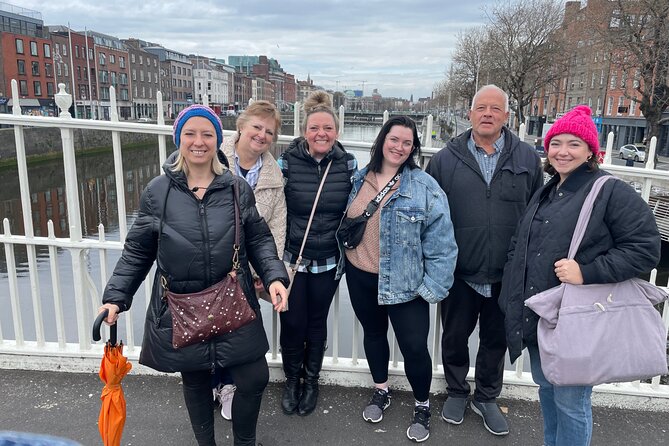
Next comes the Ha’penny Bridge, officially the Liffey Bridge. Built in 1816, it was Dublin’s first pedestrian bridge. Its familiar name refers to the half-penny toll once charged to cross it.
This is a short photo and orientation stop, not a long historical visit. Still, the bridge helps you understand the River Liffey as a divider and connector between the north and south sides of central Dublin.
Temple Bar follows for about 15 minutes. The district is Dublin’s best-known nightlife and culture quarter, with pubs, restaurants, and traditional Irish music. Your guide points out notable pubs and places to consider for food.
Here, I would listen carefully but keep your expectations sensible. Temple Bar is famous, central, and easy to reach, but it is also one of the city’s most tourist-focused areas. A guide can help you see beyond the colorful fronts and identify places that fit your interests. The point of this stop is not to spend the evening there. It is to understand what the district offers and then decide if you want to return.
A completely different kind of day out from Dublin:
- Dublin to Cliffs of Moher, including Wild Atlantic Way and Galway
★ 5.0 · 23,331 reviews - From Dublin: Cliffs of Moher, Burren & Galway City Day Tour
★ 4.8 · 18,888 reviews - Dublin: Guinness Storehouse Entry Ticket
★ 4.6 · 16,863 reviews - Dublin to Cliffs of Moher, Burren, Wild Atlantic Way, Galway Tour
★ 5.0 · 12,924 reviews
Viking Dublin at Wood Quay
At Wood Quay Amphitheatre, the tour turns to Dublin’s earliest urban story. Archaeologists found major Viking settlement remains near the area, described as the largest Viking settlement outside Scandinavia. Vikings first came as raiders and traders before settling permanently in Dublin in 841 AD.
The stop lasts about 15 minutes. It does not offer the same visual drama as a cathedral or castle, so the guide’s explanation matters. This is a good place to ask how Dublin grew from a settlement into a trading center and then into the city you see today.
The location also helps you connect modern public buildings with older layers beneath the streets. You may find this stop more interesting if you enjoy archaeology and city development than if you want a long list of famous monuments.
Christ Church and Saint Patrick’s Cathedral
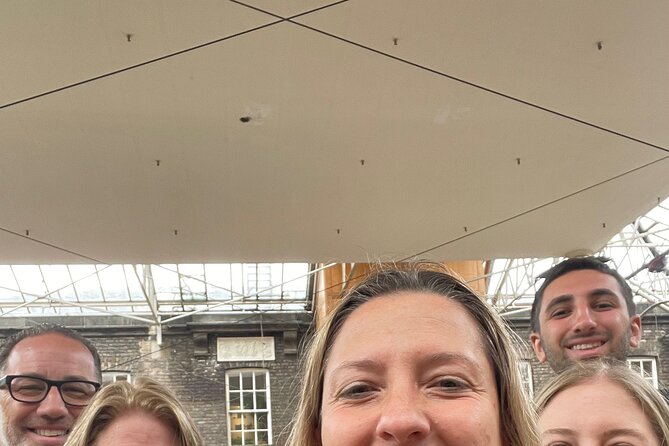
Christ Church Cathedral sits in the medieval heart of Dublin. It began as a Viking church and has welcomed pilgrims and visitors for nearly 1,000 years. The cathedral includes Strongbow’s tomb and a copy of the Magna Carta, giving the stop both political and religious weight.
You get around 15 minutes here, and admission is not included. That is enough for an exterior look and an explanation of why Christ Church matters, but you will need a separate ticket if you want to inspect the interior and its details.
Saint Patrick’s Cathedral comes next, also for about 15 minutes. The present building was completed between 1225 and 1270 in honor of Ireland’s patron saint. The site is associated with Saint Patrick baptizing Irish Gaelic people and converting them to Christianity. Jonathan Swift’s tomb is one of the best-known features inside.
Again, admission costs extra. The two cathedral stops are useful together because they show Dublin’s medieval religious center, but the short timing means you should not treat them as complete visits. If either cathedral is high on your list, ask your guide how to return after the tour and budget for both the time and ticket price.
Dublin Castle and the story of British rule
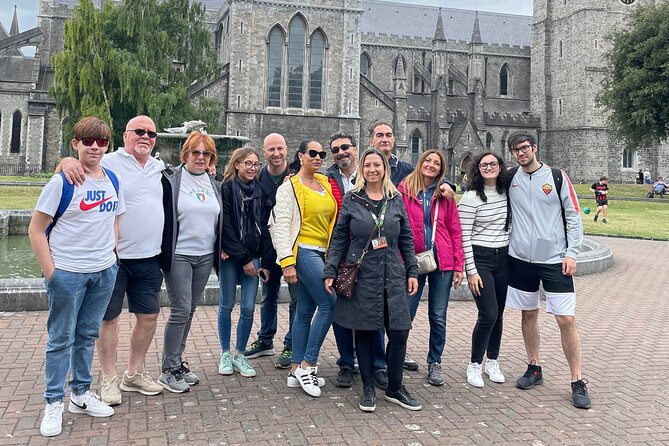
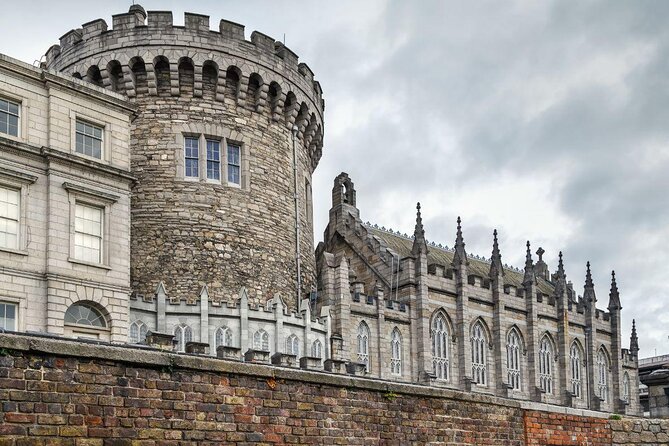
Dublin Castle was the seat of the viceroy, the representative of the English monarch in Ireland, for more than 700 years. It is one of the clearest places on the route for understanding how English rule operated from Dublin.
The Record Tower is the only remaining part of the original medieval castle. Much of what you see today consists of State Apartments built in the 18th century. That contrast is worth noting: the site looks like one grand complex, but its buildings belong to different periods and political purposes.
The tour allows about 20 minutes here, the longest stop apart from Trinity College. Admission is not included. You can use the walk to decide if a full castle visit belongs on your schedule. The exterior explanation will help you understand the place, while an interior visit gives you more time with the State Apartments and surviving medieval section.
Dublin Castle can be a serious history stop, so this is another moment when a private guide is useful. You can ask about the long period of British administration, rather than treating the castle as just another photogenic building.
George’s Street Arcade and Molly Malone
George’s Street Arcade offers a lighter change of pace. Located in Dublin’s creative quarter, it is the city’s oldest shopping center and one of its best examples of Victorian architecture. It has operated for almost 140 years as part of the South City Market buildings, with shops and stalls selling different types of goods.
The stop lasts about five minutes. You will get a quick look rather than time to browse every stall, so mark it as a place to revisit if you enjoy small shops and market-style browsing.
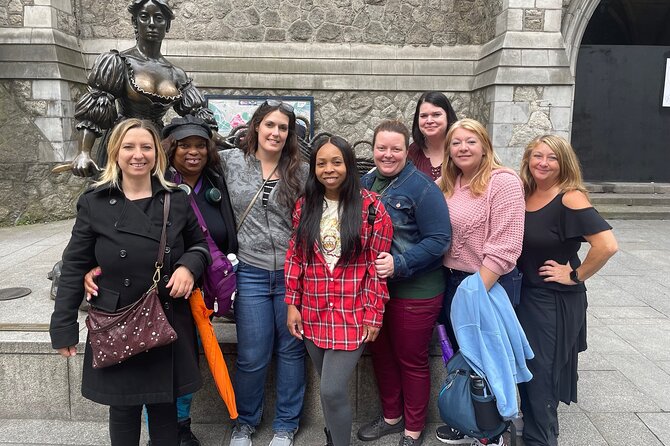
The tour ends at the Molly Malone statue on Suffolk Street. The statue was unveiled in 1988 for Dublin’s first millennium celebration. Molly Malone is linked to the song that became Dublin’s unofficial anthem, though it is not certain that she was a real person. One theory connects her to a woman who died in Dublin in 1699.
This is a convenient end point in central Dublin. You can take photos, continue toward nearby sights, or use the guide’s final recommendations to shape the rest of your day.
What the guides add to the experience
The strongest part of this tour is the guide’s role. Sinead was praised for tailoring a walk to her group and then adjusting it as she learned what they enjoyed. John handled questions well and made the route suitable for children aged 6 and 8.
Francesca received praise for a friendly two-hour overview, and Yvonne was noted for explaining different periods of Irish history and why they mattered to Dublin. These details suggest a style that is warm and adaptable rather than fixed and lecture-heavy.
That flexibility is particularly useful for families, first-time visitors, and anyone with a special interest in literature, politics, churches, food, or local culture. You can ask for more detail at the stops that matter to you and keep moving at the less important ones.
The available feedback is very strong, with a five-star rating from 18 reviews and 100 percent recommending the experience. That is encouraging, though it is still a small sample. I would value the repeated praise for friendly, clear guiding more than the perfect percentage itself, because those qualities affect the walk directly.
Price, tickets, pace, and practical value
At $90.11 per person, this is not Dublin’s budget introduction. The price makes the most sense if you are traveling as a small group and want private attention, questions answered, and advice shaped around your interests.
Remember to add possible entrance fees. Trinity College, the GPO Museum, Christ Church Cathedral, Saint Patrick’s Cathedral, and Dublin Castle all list admission as not included. You can keep the day affordable by treating the walk as an outside orientation, or spend more by returning to the interiors that interest you most.
The route uses central streets and is near public transportation. Most people can take part, and service animals are allowed. Since it requires good weather, bring practical rain protection and shoes suitable for several hours on city pavement. The tour is offered in English.
Free cancellation is available up to 24 hours before the start time. Changes or cancellations inside that window are not refunded, and poor weather may lead to another date or a full refund.
Who should book this Dublin walking tour?
You should consider it if you want a strong first-day introduction, prefer a private guide, or like asking questions as you go. It is also a good fit for families, since the route can be adjusted and John’s experience with children shows that the walk need not be an adult-only history lesson.
I would be less keen on it if you want long interior visits, a food tour, or a slow specialist tour of just one subject. The route covers 11 stops, and several are brief. You will gain breadth, but you must return later for depth.
Should you book it?
Book this private Dublin walking tour if you want to get your bearings quickly and connect Dublin’s major eras in one walk. The combination of Trinity College, the GPO, Viking settlement, two cathedrals, Dublin Castle, and central neighborhoods gives you plenty of useful context.
The price is justified when personal guiding matters to you. If $90.11 per person feels high, compare it with your plans: you are paying for a private route and a guide who can adapt, not for admission to every attraction. For many first-time visitors, that personal introduction is worth it. Just keep extra time and money for the interiors you most want to see.
FAQ
How long does the private walking tour last?
The tour lasts approximately 2 to 3 hours. The listed stops add up to about two hours and fifteen minutes, but the exact length can vary.
Where does the tour begin?
It begins at Trinity College Dublin, College Green, Dublin 2, Ireland.
Where does the tour finish?
The tour ends in front of the Molly Malone statue on Suffolk Street, Dublin 2.
Is this a private tour?
Yes. Only your group participates in the activity.
What language is the tour offered in?
The tour is offered in English.
Are admission fees included?
No. Admission is not included at Trinity College, the GPO Museum, Christ Church Cathedral, Saint Patrick’s Cathedral, or Dublin Castle. The Spire, Ha’penny Bridge, Temple Bar, Wood Quay Amphitheatre, George’s Street Arcade, and the Molly Malone statue are listed as free stops.
Can I cancel for a full refund?
Yes, if you cancel at least 24 hours before the experience start time. Cancellations or changes made less than 24 hours before the start time are not refunded, and poor weather may result in another date or a full refund.
Just added around Dublin
- A Self Guided Walking Tour of Dublin’s Docklands★ 4.5 · 3 reviews
- Waterford Crystal and Kilkenny Full-Day Rail Tour from Dublin★ 5.0 · 3 reviews
- Secret and unusual Dublin: guided walking tour★ 5.0 · 3 reviews
- Turtle Bunbury’s Dublin: A Self-Guided Audio Tour from a Celebrated Author★ 5.0 · 3 reviews
- Cliffs of Moher and The Burren Private Tour from Dublin★ 5.0 · 3 reviews
- Skip-the-line St. Patrick’s Cathedral and Dublin City Tour★ 5.0 · 3 reviews
- Dublin Full-Day Tour through Boyne Valley★ 5.0 · 3 reviews
- Rock Of Cashel And Blarney Castle Private Chauffeur Full Day Sightseeing Tour★ 4.5 · 3 reviews
Walking Tours, compared.
Dublin Highlights and Hidden Gems Guided Walking Tour
Read our review →

90 Minute Dublin Walking tour and Sightseeing tips
Read our review →

Historical 2-Hour Guided Walking Tour of Dublin
Read our review →
Dublin Traditional Irish 3 Course Meal Walking Tour with Local
Read our review →
Browse the lists this tour appears in